When IR Works in Denver and When It Does Not
Infrared thermography for commercial roof moisture detection in Denver - the dry summer windows that work, the conditions that don't, and how IR combined with core sampling produces confident moisture mapping for Denver's large commercial buildings.
Denver's climate creates specific IR windows that work and specific conditions that produce unreliable thermograms. Dry summer evenings in June and July - after the solar load has charged the insulation - offer one of the better IR windows in the country when no storm precedes the scan. We use that window deliberately, not by default.
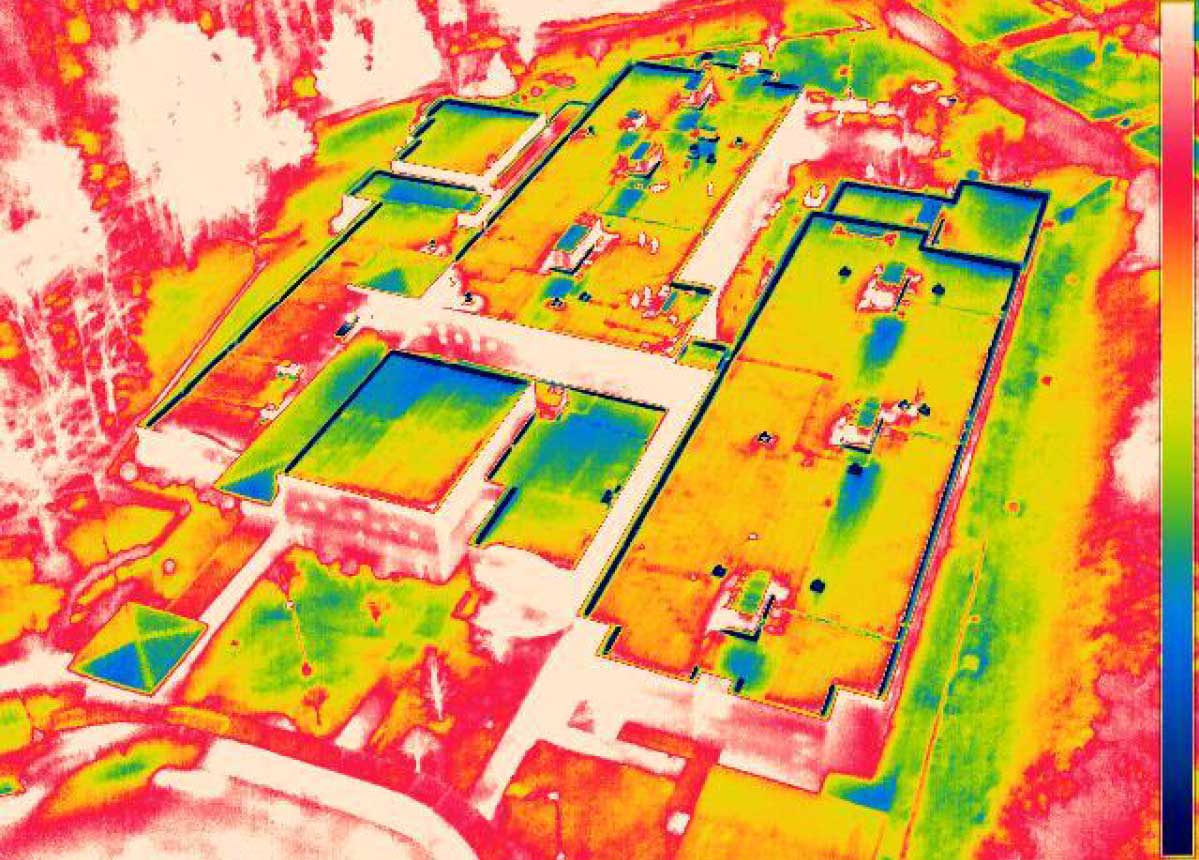
Infrared scanning for commercial roofing operates on a physical principle that Denver's climate amplifies: wet insulation retains heat longer than dry insulation after the sun goes down. A thermal camera scanning the roof surface in the hours after sunset detects the moisture zones as warmer anomalies against the cooling dry field. Denver's combination of intense high-altitude solar loading - UV radiation is 25 to 30 percent more intense at 5,280 feet than at sea level - and rapid evening temperature drops creates some of the strongest differential conditions in the country for IR scanning when the surface is dry and clear.
The dry summer windows - June through August on nights that follow clear, sunny days without recent precipitation - are among Denver's best IR scanning opportunities. The roof charges intensely under 8-plus hours of direct high-altitude sun, and evening temperatures drop rapidly in Colorado's low-humidity atmosphere, creating strong differential between wet and dry insulation zones. This is the opposite of Dallas or Houston, where summer nights cool slowly and suppress IR signal. Denver summers reward a strategically timed scan.
The limitation is storm sequencing. Denver's May-through-August hail season means that the same summer window that produces ideal IR solar loading also produces frequent precipitation events that create false-positive moisture signatures on the membrane surface and suppress the insulation temperature differential. We assess weather conditions in the 48 to 72 hours before each scheduled IR scan and reschedule if precipitation or cloud cover compromises the scan quality. We do not run IR scans under conditions that produce ambiguous thermograms - and we do not use IR as a standalone deliverable for recover-versus-replace decisions regardless of scan quality.
Conditions that produce clear, usable thermograms in Denver: At least 6 hours of direct solar loading during the day - Denver's high-altitude sun achieves this readily on clear summer days. A temperature differential of at least 20°F between the roof surface and ambient air at scan time. No precipitation in the prior 48 hours - wet membrane surface from rain or hail creates false-positive anomalies across the full field. Wind below 15 mph - Denver's Front Range and Chinook wind events can suppress surface temperature differential. No cloud cover during the solar loading period.
Conditions that produce ambiguous or unreliable thermograms in Denver: Precipitation within 48 hours of the scan - hail events, which are common May through August, require a minimum 72-hour dry-out before the membrane surface returns to a condition where false positives are manageable. Early-season snow in October that melts and re-freezes suppresses IR reliability into November. White or light-gray reflective TPO membranes, which are the standard Denver specification for energy code compliance, absorb less solar energy and produce a weaker differential between wet and dry zones - IR still works on these surfaces but requires more careful interpretation.
The October pre-snow inspection window is often better for IR than mid-summer on many Denver buildings, particularly those with reflective membranes. Daytime temperatures in September and October still produce meaningful solar loading on non-reflective sections, while evening temperatures drop rapidly - sometimes 30 to 40°F between afternoon peak and midnight - creating strong differential. The absence of the summer storm-cycle interference makes scan timing more reliable.
How We Use IR With Core Sampling in Denver
On large Denver commercial buildings - 60,000 sq ft and above - we use IR to produce a candidate moisture map, then pull cores at each significant anomaly zone to confirm the finding. We also pull cores at several zones that read as dry in the thermogram to confirm the IR interpretation is accurate for this specific roof and condition.
This combined approach is particularly valuable on the large-footprint industrial and warehouse buildings along the I-70 corridor in Commerce City, the Globeville distribution zone, and the Centennial and Lone Tree commercial parks. A 200,000 sq ft distribution facility with uniformly aged TPO and no prior moisture data would require 40 to 50 cores in a grid pattern to produce statistically meaningful coverage without IR. IR combined with targeted cores produces equivalent confidence at 15 to 20 pulls, which is both faster and less disruptive to the membrane during an active leasing period.
The combined deliverable is a moisture distribution map with each zone coded as confirmed-wet by core verification, probable-wet by IR anomaly only, or dry by both IR and core. This three-level classification tells the owner where the data confidence is high versus where it is inferred - a distinction that matters when the recover-versus-replace cost difference is significant.
Equipment and Report Format
We use FLIR commercial-grade radiometric thermal cameras calibrated for roofing applications. Every thermogram is captured at full radiometric resolution, and the report delivers the thermogram alongside the visible-light photograph of the same zone - so every anomaly in the thermogram corresponds to a visible-light photo showing the membrane surface at that location. Calibration records are available for any project where the IR report will be used in insurance, litigation, or acquisition due-diligence contexts requiring equipment documentation.
The IR report is formatted as an addendum to the condition report, not a standalone document. The moisture survey findings - IR anomalies, core confirmations, moisture distribution map - integrate into the full condition record so the owner has a single document set for capital planning, warranty coordination, and any subsequent claim or acquisition process.
Frequently asked questions
Can infrared scanning be done during the day in Denver?
Daytime IR does not detect moisture in roofing insulation - the roof surface is uniformly heated by solar radiation and the differential between wet and dry zones is suppressed. Roofing IR is an after-sunset procedure, conducted two to four hours after solar peak when the surface has begun to cool and wet zones are retaining heat relative to the cooling dry field. Denver's rapid evening temperature drops - 20 to 40°F between afternoon peak and late evening in the fall months - actually make post-sunset timing more precise here than in high-humidity coastal markets where cooling is slower.
Is the dry summer window in Denver actually usable given hail frequency?
Yes, with scheduling discipline. The summer window is high-value on nights that follow 48-plus hours without precipitation - and Denver does have extended dry periods through June, July, and August between storm events. We monitor weather conditions and reschedule scans when the 48-hour window is not clear. We do not run scans in the days immediately following a hail event, because surface moisture from rain and hail suppresses the insulation differential and produces false positives. When a clear window opens, we take it.
Does IR work on reflective white TPO membranes, which are standard in Denver?
Yes, with modified interpretation. White and light-gray reflective membranes absorb less solar energy and produce a smaller temperature differential between wet and dry zones, which makes the thermogram harder to read than on a dark membrane. We account for this in the scan timing - reflective membranes often require scanning earlier in the evening, closer to the solar peak, when the differential is stronger before the entire surface cools uniformly. On roofs where reflective membrane reduces IR signal quality significantly, we recommend higher core density to supplement the IR findings.
What is the best time of year for IR scanning in Denver?
Two windows are reliable: dry summer evenings from June through August following 48-plus hours without precipitation, and September through October before the first significant snow. The September-October window is often preferred for portfolio scheduling because it aligns with the pre-snow inspection cycle and avoids storm-sequence interference. The summer window produces the strongest solar loading but requires more careful weather monitoring around Denver's afternoon thunderstorm and hail pattern.
| Scope Format | Written roof plan and photo record |
|---|---|
| Primary Market | Denver commercial buildings |