Membrane and Assembly Selection for Denver Warehouse Conditions
Large-deck warehouse roofing across the Commerce City, Aurora I-70, and DIA logistics corridor - mechanically attached and fully adhered TPO, FM-approved assemblies, impact-rated cover board for Colorado hail exposure, and phased production around 24-hour distribution operations.
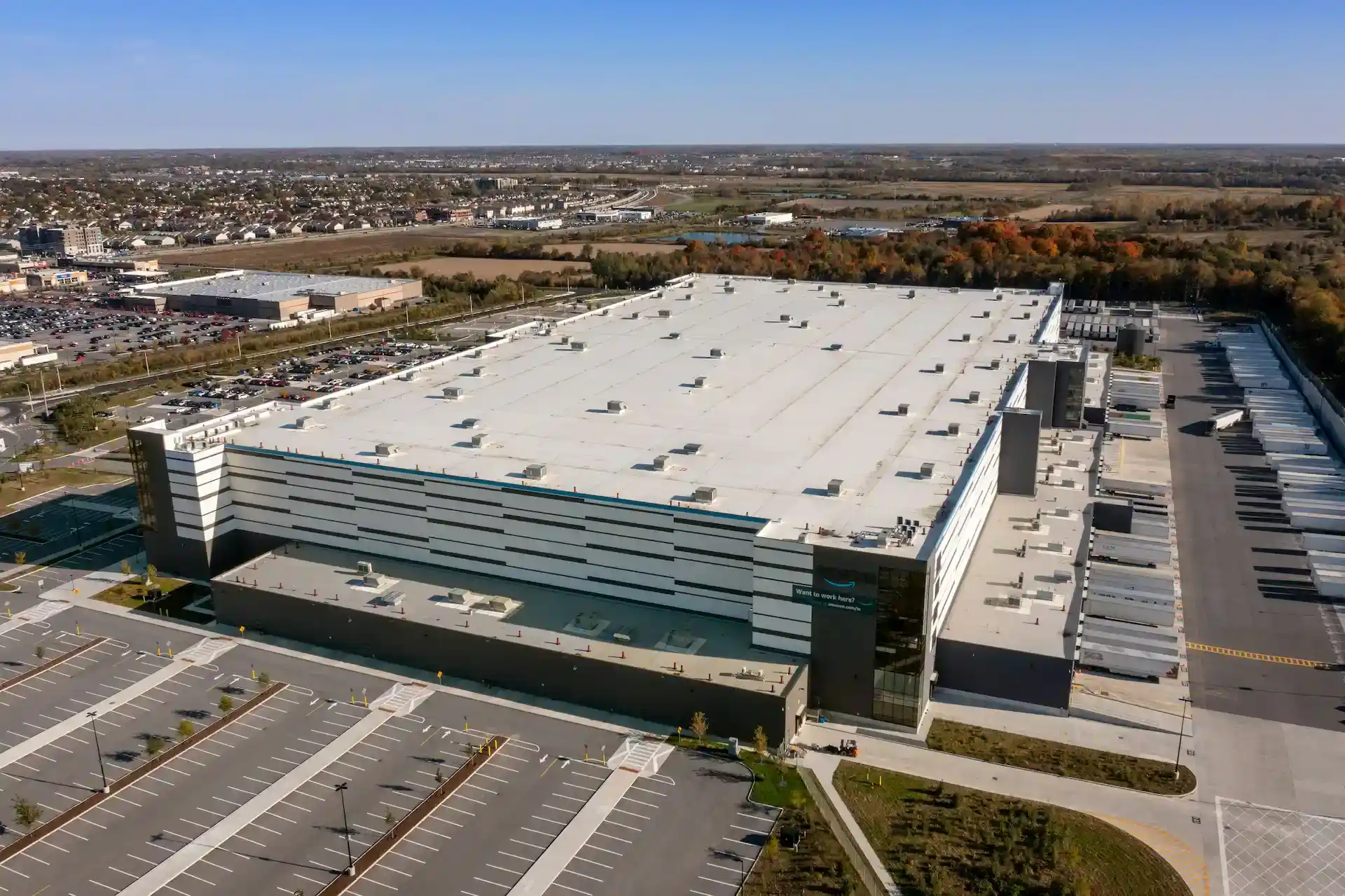
Commerce City industrial parks, Aurora's I-70 logistics belt, and the DIA cargo and distribution corridor represent the largest concentration of commercial flat roof square footage in Colorado. Our warehouse crews know the sequencing that keeps distribution operations running beneath us while we work above.
Large-deck warehouses create roofing problems that do not appear on smaller commercial buildings. A 400,000 sq ft distribution center has wind-uplift requirements in Denver's open-terrain exposure that drive fastener density far beyond a suburban office building spec. The DIA corridor specifically sits in one of the highest sustained-wind zones on the Front Range - Chinook events along the I-70 mountain corridor push documented gusts above 60 mph through this area in winter and spring, and wind-uplift design for that exposure is not interchangeable with a sheltered urban site calculation. We run ASCE 7-22 wind-uplift calculations for each building we scope and specify fastener patterns accordingly.
The other defining variable for Denver warehouse roofing is Colorado's hail environment. The I-70 corridor east of downtown Denver - including the Commerce City, Aurora, and Stapleton logistics zones - sits in one of the highest-frequency hail belts in Colorado, with documented severe events most years from May through August. Impact-resistant cover board specification is not optional on these roofs. Every warehouse reroof we scope in this market includes HD polyiso or HD gypsum cover board as the baseline, not an upgrade.
Fully adhered TPO is specified over mechanically attached for Denver warehouse buildings in high wind-uplift zones and on buildings where the existing deck condition makes additional mechanical fastener penetrations a concern. The DIA corridor and the open-terrain zones east of Aurora are the most common fully-adhered applications in our warehouse portfolio. The adhesive bond eliminates the membrane flutter under sustained Chinook wind loads that accelerates seam stress in mechanically attached systems on large-footprint roofs with long unsupported membrane spans.
Tapered insulation packages are standard on Commerce City and north Denver warehouses built in the 1970s and 1980s. Original construction minimized slope to interior drains - code-minimum slope that is now further compromised by 40 years of insulation settlement and partially obstructed drain bowls. We design taper packages around actual existing drain locations and documented ponding patterns from our inspection walk, not a generic engineered-slope drawing applied to every building.
Coordinating Production Around Distribution Operations
Pre-construction for any active distribution center includes a meeting with the facility manager to document the operations layout, identify the inbound and outbound dock positions, and establish the phase sequence that keeps the most operationally sensitive zones working until last. We use vacuum-equipped tear-off equipment that pulls modified bitumen and old insulation directly to containers rather than staging debris on the roof surface above active operations. All penetrations are sealed same-day before any crew departure, regardless of where the broader section completion stands.
Cold-storage facilities in the Denver warehouse market - refrigerated distribution operations are present across both Commerce City and the Aurora I-70 corridor - add a further constraint: even a temporarily unsealed penetration over a 35-degree refrigerated zone compromises interior temperature control and risks inventory. We plan cold-storage section work in defined daily windows with the interior refrigeration crew on standby, and we do not open the next section until the prior one is fully sealed.
Federal and FM Global Requirements on DIA Corridor Buildings
Several large distribution tenants in the DIA logistics corridor - including major e-commerce fulfillment and parcel operations - carry FM Global property insurance, which requires FM-approved assembly specifications on all commercial roofing work performed on their facilities. FM Global approval is an assembly rating, not a membrane brand rating - the full system (membrane, cover board, insulation, attachment method) must be specified by FM approval number, installed per the approved configuration, and documented at closeout with the assembly number in the warranty package.
We specify FM-approved assemblies by assembly number, verify every component on delivery matches the approved configuration, and document the FM approval number in the project closeout file. For DIA corridor distribution buildings where tenants hold FM Global policies, we confirm the coverage requirement during pre-construction and build the assembly specification around the specific FM approval the tenant's insurer requires - not a generic Class 1 claim.
Frequently asked questions
Can warehouse reroof production work around 24-hour distribution operations in the DIA corridor?
Yes, with detailed pre-construction planning. We coordinate production windows with the facility's operations schedule, sequence tear-off away from active dock positions, seal all penetrations before shift change, and use vacuum-equipped equipment to eliminate debris risk over active operations. We have coordinated around continuous operations on multiple Commerce City and Aurora I-70 corridor facilities.
Why is cover board non-optional on Denver warehouses?
The I-70 industrial corridor east of Denver sits in one of Colorado's highest hail-frequency zones. Impact-resistant cover board - HD polyiso or HD gypsum - is what makes an FM 4470 Class 1 or UL 2218 Class 4 assembly rating achievable. Without it, the membrane passes a factory test but fails in field conditions because standard-density insulation compresses under hail impact, allowing the membrane to flex beyond its rated tolerance. We include cover board in every Denver warehouse reroof spec.
How do you handle wind-uplift design for DIA corridor warehouses?
The DIA corridor and open terrain zones east of Aurora are among the highest wind-uplift exposure categories in the Denver metro. Chinook events produce documented sustained gusts above 60 mph in this corridor. We run ASCE 7-22 wind-uplift calculations for each building and specify fastener density accordingly - there is no generic fastener pattern we apply to every warehouse regardless of exposure category.
How do you stage material delivery for a 400,000 sq ft reroof?
We stage in daily production sections - typically 20,000 to 40,000 sq ft - with material deliveries matched to daily output. The DIA and Aurora corridor warehouses have laydown areas at grade that allow daily crane or telehandler staging without overloading the deck. We provide a written zone-by-zone production schedule before contract signing.
Get a warehouse roof scope for your Denver distribution facility.
Our project managers will walk the full deck, document equipment penetrations, pull moisture cores where ponding or insulation saturation is suspected, and deliver a written scope with production phasing based on your operations schedule.
| Scope Format | Written roof plan and photo record |
|---|---|
| Primary Market | Denver commercial buildings |