Core Sampling Protocol
Commercial roof moisture surveys for Denver buildings - core sampling protocol, moisture distribution mapping, and recover-versus-replace decision support calibrated to Colorado's freeze-thaw environment.
Denver's 90-to-110 annual freeze-thaw cycles make wet insulation under a commercial roof more destructive than in most US markets. Core sampling and moisture distribution mapping tell you how much of the insulation is saturated and where - the numbers the recover-versus-replace decision requires.
The most expensive roofing mistake in Denver is recovering a roof with saturated insulation. A recover installs a new membrane over the existing system. In Denver's freeze-thaw environment - 90 to 110 cycles per year, with temperatures crossing the freezing threshold repeatedly through fall and spring - trapped moisture in the insulation below the new membrane becomes an expansion-contraction engine. The moisture freezes and thaws, degrading the membrane bond, buckling the cover board, and corroding the deck below. Five to eight years after the recover, the building faces a full tear-off of the new membrane, the old membrane, damaged insulation, and often corroded deck sections - a project that costs two to three times what a full replacement would have cost at the original decision.
Moisture survey is the tool that makes the recover-versus-replace decision defensible. We core-sample roofs to pull direct physical evidence of insulation condition at representative locations across the roof area. We map the distribution of wet zones to understand both the percentage of the roof area affected and the spatial pattern - clustered moisture around drains and parapet corners suggests discrete long-term leak sources; dispersed moisture across multiple zones suggests systemic saturation from years of diffuse infiltration.
Denver's commercial roof stock has specific moisture patterns by building type and age. The industrial and warehouse inventory from the 1970s and 1980s in the Globeville, Elyria-Swansea, and the I-70 Commerce City corridors commonly shows moisture concentrated at drains and parapet walls where original flashings failed incrementally. The Class A and B office inventory from the 1990s energy-sector boom along 17th Street tends to show moisture at penetration clusters where decades of equipment additions created non-standard flashing conditions. Knowing those patterns informs where we sample for statistical confidence.
We pull cores with a 4-inch diameter core cutter at representative locations identified before the site visit by review of the existing inspection record, drain layout, building history, and any interior staining reports from the facility manager. Each core pulls through the membrane and the full insulation stack to the deck surface. We record the number of plies on multi-ply systems, the insulation type and thickness, the condition of each layer, and whether the insulation is wet, damp, or dry by direct physical assessment - not inference from surface conditions.
Core density scales with roof area and the decision at hand. For a 50,000 sq ft roof with no prior moisture data, we pull a minimum of 15 to 20 cores in a grid pattern plus targeted cores at high-probability locations: drain basins, parapet corners, penetration clusters, and any area where prior inspections flagged membrane conditions consistent with active water migration. For a roof where prior inspection identified specific suspect zones, we concentrate cores in those zones at higher density and confirm with scattered cores in presumed-dry areas to establish the extent of moisture migration.
Each core location is repaired with membrane-matching material and resealed before we leave the site. Core locations are logged on the zone diagram by number, creating a permanent record of where each core was pulled and what it found. That record is useful for future inspections and for any subsequent moisture survey - if a core at a specific location came back dry in one survey, the next survey can pull the same location to assess whether conditions have changed.
Moisture Distribution Mapping and Decision Thresholds
Core results are plotted on the zone diagram to produce a moisture distribution map. Wet, damp, and dry cores are marked distinctly. The spatial pattern the map reveals drives the interpretation: clustered moisture in specific zones indicates discrete failure sources that may be remediable with targeted tear-out and recover; dispersed moisture across multiple disconnected zones indicates systemic saturation that makes recover inadvisable regardless of the percentage.
The 25-percent threshold is the standard recover-versus-replace decision point: if more than 25 percent of the roof area shows wet or significantly damp insulation, recovering is not a defensible scope in Denver. Recover manufacturers will not warrant a system installed over wet insulation, and Denver's freeze-thaw cycle makes the consequence of trapped moisture more severe and faster-acting than in lower-altitude markets. Below 25 percent, a selective-tear-off recover - where wet zones are torn off to the deck, the deck is inspected and repaired where needed, and only those areas receive new insulation before the recover membrane - is a legitimate capital option at roughly 40 to 60 percent of full replacement cost.
We present the decision analysis in writing with the moisture distribution map and core data as supporting documentation. The recommendation is one of three: recover option with selective wet-area tear-out, full replacement, or in rare cases a staged approach where the most critical sections are replaced immediately and the remainder is maintained under a monitored timeline.
Sample Density and Statistical Confidence
A five-core sample on a 100,000 sq ft roof does not produce statistically meaningful data - five evenly spaced cores could easily miss a 15,000 sq ft wet zone between them. We size the core count to produce a statistically defensible result for the specific decision.
For recover-versus-replace decisions, we want enough cores to determine with confidence whether the wet-area percentage is above or below the 25-percent threshold, not a best-guess estimate. For acquisition due diligence, we size the sample to estimate the magnitude of the moisture liability within a range that supports the capital model - which requires coverage of the full roof area at a density that would not miss a zone larger than 5,000 sq ft. We document the sample density and the confidence level in the moisture survey report so the owner knows what the data actually supports.
Frequently asked questions
Does core sampling damage the Denver roof?
Minimally and temporarily. Each core leaves a 4-inch diameter opening that we repair on the same site visit with membrane-matching material - TPO patch on a TPO roof, EPDM patch on EPDM, modified bitumen patch on modified bitumen. The repair is watertight before we leave the site. In Denver's climate, leaving a core open overnight is not acceptable practice; we complete all repairs on the same visit regardless of the number of cores pulled.
Why is wet insulation more serious in Denver than in other markets?
Denver's 90 to 110 annual freeze-thaw cycles make trapped moisture more destructive than in most US commercial markets. When saturated insulation freezes and thaws repeatedly through the fall-spring transition, it degrades the membrane bond above it and accelerates corrosion of the metal deck below it. The consequence of recovering a Denver roof with wet insulation is not just reduced insulation performance - it is active structural deterioration over the next five to eight years that results in a more expensive tear-off and deck replacement project.
When is moisture survey combined with infrared scanning?
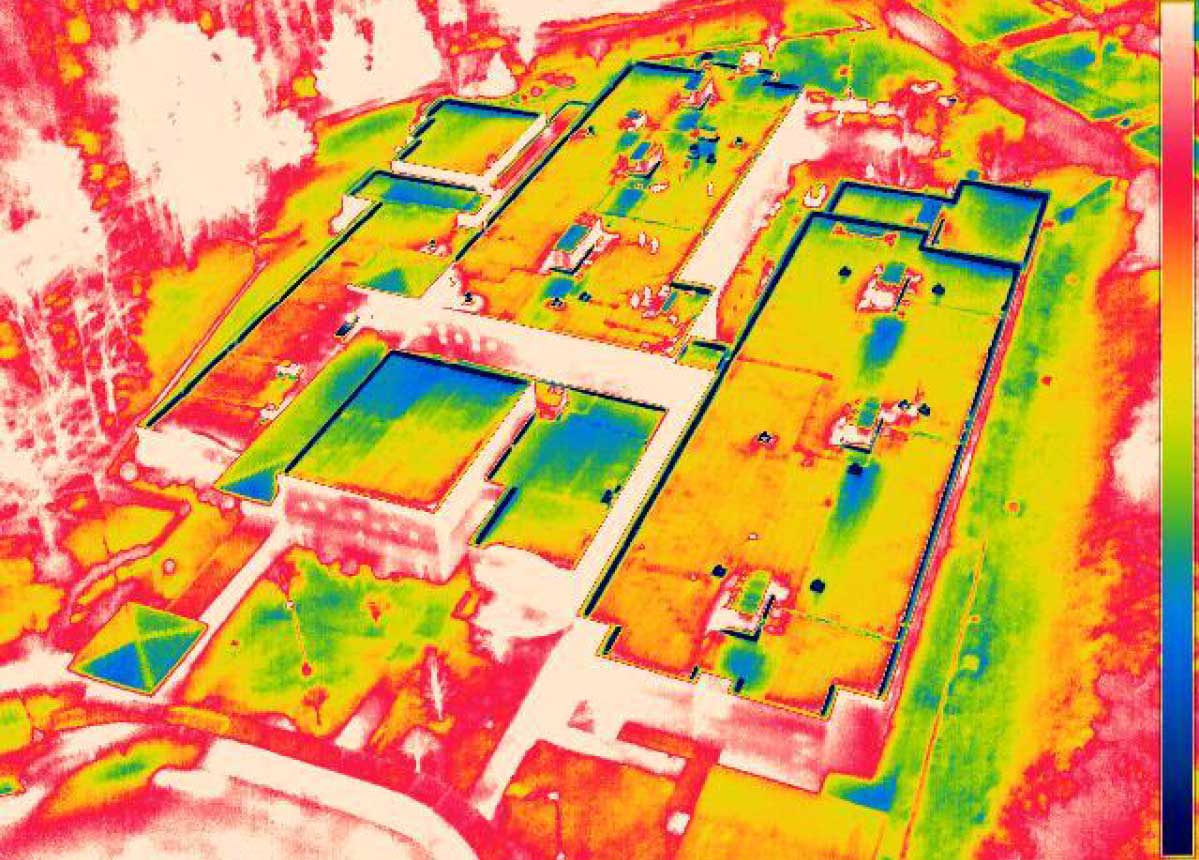
On large roofs - 60,000 sq ft and above - we often use infrared scanning in October through April to produce a candidate moisture map that narrows the core sampling program. IR identifies probable wet zones across the full roof area in a single evening scan; cores then confirm the findings at those locations. The combination produces equivalent statistical confidence at a lower core count than a dense grid-pattern core survey on the same roof. IR alone is not sufficient for the recover-versus-replace decision - it identifies probable locations, but cores provide the physical evidence.
How long does a moisture survey take on a Denver commercial building?
For a 50,000 sq ft building with 15 to 20 cores, the site work takes four to six hours including core pulling, repair, and documentation. Larger buildings or high-density grid surveys take proportionally longer. The written moisture survey report is delivered three to five business days after the site visit, formatted as an addendum to the condition record rather than a standalone document.
| Scope Format | Written roof plan and photo record |
|---|---|
| Primary Market | Denver commercial buildings |