Class 4 Hail Rating and Snow-Shed Design for Colorado Buildings
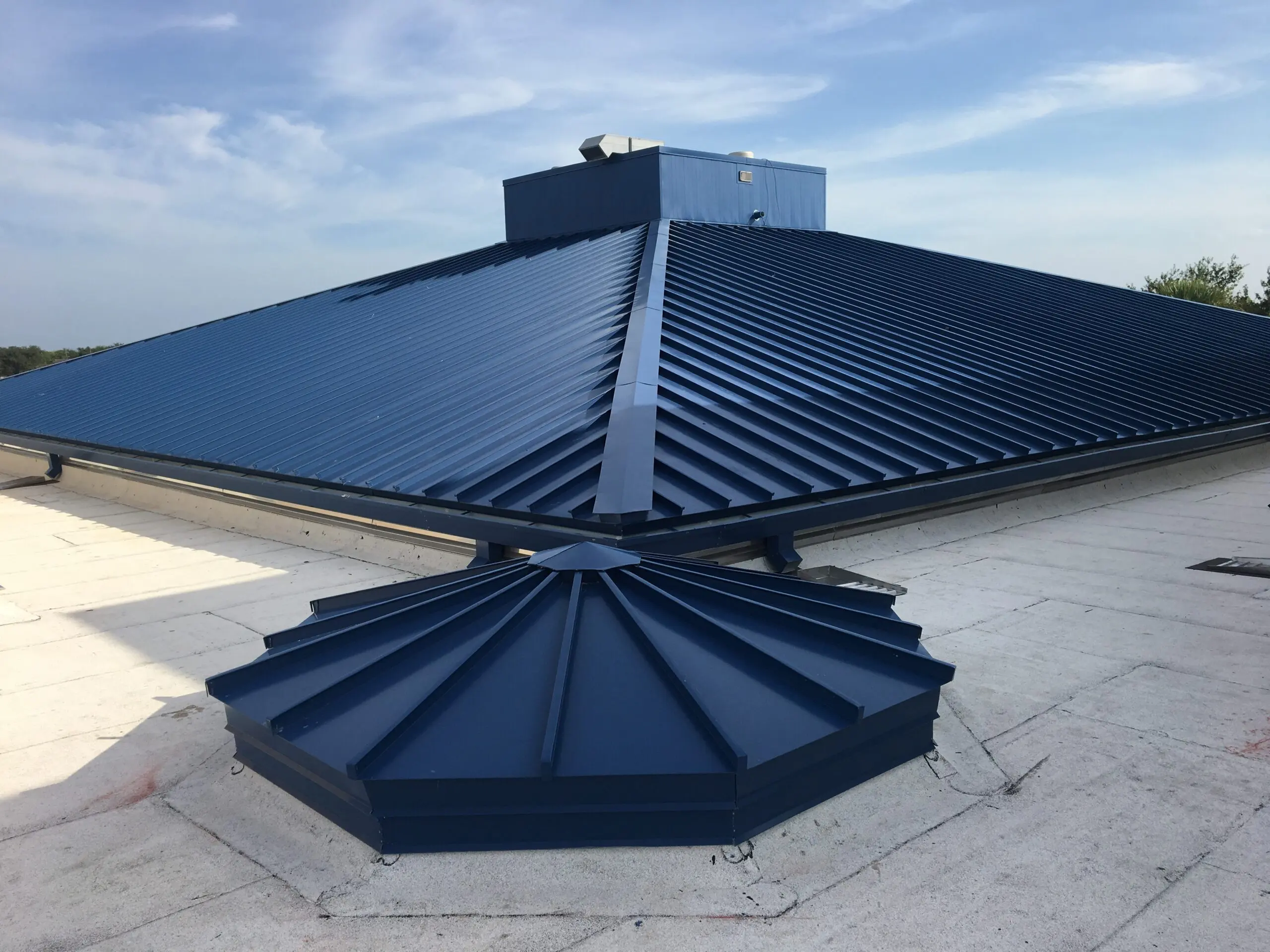
Standing seam metal roofing for Denver commercial buildings - Class 4 hail-rated Galvalume and Kynar-painted panel systems, engineered for Colorado's 30 psf snow load, passive snow-shed design, and the 40 to 50-year system life that makes metal the right specification for institutional and architectural buildings across the Front Range.
Standing seam metal is the roof system of choice for Denver buildings where 40-year system life, Class 4 hail resistance, and passive snow management define the specification. We install Galvalume and Kynar-painted panel systems on religious facilities, schools, institutional buildings, and architectural commercial projects across the Front Range - engineered against Colorado's 30 psf snow load and the largest hailstones the metro produces.
Standing seam metal roofing occupies a premium position in Denver commercial work for reasons that are directly tied to Colorado's climate. The Front Range hail season produces documented hailstones that puncture and compromise single-ply membrane systems annually - standing seam Galvalume or Kynar-painted steel panels are inherently impact-resistant without requiring the cover board specification that qualifies single-ply for Class 4 ratings. The system's passive snow-shed profile - the raised seam allows snow to release from the slope rather than accumulating as a dead load - is a functional advantage on Colorado commercial buildings with pitched rooflines.
Standing seam is not the right system for every Denver commercial building. It costs more than single-ply membrane, requires more precision in installation, and is not appropriate for flat or very low-slope commercial roofs where thermal expansion would require sealed seam profiles at minimal slope. But for buildings where the roof is part of the architectural statement - religious facilities, schools, adaptive-reuse projects in RiNo and the Highlands neighborhood, institutional buildings across the metro - standing seam delivers a 40 to 50 year system life that single-ply cannot match.
Our standing seam work is field-fabricated on most projects. We run panels on-site to the required lengths rather than ordering cut-to-length panels that produce field laps. Field-fabricated panels eliminate the field seam that is the primary failure point on standing seam systems, and the panel runs are continuous from eave to ridge without a seam that snow loading could compress.
Standing seam metal panels fabricated from 24-gauge or heavier Galvalume steel meet UL 2218 Class 4 impact resistance without additional cover board specification. The metal substrate - unlike single-ply membrane over insulation - does not compress under hail impact. A 2-inch stone that would puncture or delaminate a single-ply assembly leaves a dent in Galvalume that is cosmetic rather than structural, and does not compromise the panel's waterproofing function. Most Colorado commercial property insurers apply the same Class 4 premium reduction to standing seam metal as they do to rated single-ply assemblies - we document the panel specification and UL rating at closeout.
Passive snow-shed is a functional specification requirement on Denver commercial buildings with adequate slope - typically 3:12 or steeper. The raised standing seam profile creates a snow release surface that allows accumulated snow to slide off the slope rather than building as structural dead load. On buildings in the foothills communities to the west - Golden, Evergreen, Conifer - where design snow loads significantly exceed Denver's 30 psf ground snow load, passive snow-shed on a standing seam system is a structural load management tool, not just an aesthetic choice. We engineer the panel attachment and thermal-movement clips against the calculated snow and seismic loads for each project location.
Galvalume vs Kynar-Painted Panels for Front Range Conditions
Galvalume - aluminum-zinc alloy coated steel - is the base specification for standing seam metal in Denver commercial applications. The zinc-aluminum coating provides corrosion resistance that outperforms plain galvanized steel in Colorado's semi-arid climate, and the natural metallic finish weathers without paint maintenance requirements. For institutional and utilitarian applications - school gymnasiums, equipment enclosures, warehouse-bay roofs - bare Galvalume is often the right specification. Typical service life on a properly installed Galvalume system in Denver conditions is 40 to 50 years.
Kynar 500 (PVDF) painted systems add color selection and a second corrosion-protection layer. Kynar 500 is the coating specification required for 40-year finish warranties from most panel manufacturers - the fluoropolymer chemistry resists chalking and UV-driven fading at Denver's altitude better than polyester-based coatings that degrade in 8 to 12 years. For the RiNo adaptive-reuse projects, the Highlands commercial redevelopment zone, and religious facilities across the metro where the roof is visible from street level and the color choice matters to the design or congregation, Kynar-painted panels are the standard specification.
Thermal Movement Engineering in Denver's Climate Range
Thermal movement is the detail that most distinguishes standing seam from membrane work in Denver's climate range. The temperature differential from a January night at minus 10 degrees Fahrenheit to a June rooftop surface in direct sun at 130 degrees Fahrenheit drives significant panel expansion and contraction. A 100-foot run of Galvalume panel will move more than an inch over that range. The floating-clip system that attaches the panel to the structure must allow for that movement - any restraint point that prevents thermal expansion produces panel oil-canning, seam fatigue, or clip pull-out.
We engineer clip spacing and panel attachment against the calculated thermal movement range for each project's location and orientation. South-facing and west-facing panels at Denver's altitude experience the greatest temperature swing and require the most latitude in clip design. We submit shop drawings that include the thermal movement calculation before production begins on every standing seam project.
Frequently asked questions
How much more does standing seam metal cost than TPO on a Denver commercial building?
Installed cost for standing seam Galvalume or Kynar-painted metal runs roughly two to three times the installed cost of 60-mil TPO on the same building. The payback is a 40 to 50 year system with no re-roofing cycles during that period, inherent Class 4 hail resistance without cover board specification, passive snow-shed capacity on pitched roofs, and minimal maintenance cost. For Denver buildings with 30-plus year ownership horizons, the lifecycle math often favors metal. We run the lifecycle cost comparison for every project where the choice is close.
Does standing seam metal perform well under Denver snow loads?
Yes - standing seam metal is often the preferred specification for Colorado buildings in higher snow-load zones. The panel attachment is engineered against the structural snow load, and the passive snow-shed profile on adequate slopes reduces accumulated dead load by allowing snow to release before it reaches design-load levels. On flat or very low-slope sections of complex-geometry buildings, single-ply is typically the better specification; standing seam is appropriate where the slope supports it.
Can you install standing seam over an existing membrane roof?
Yes, in many cases - standing seam installed over an existing membrane on a raised subframing system eliminates the tear-off cost and provides additional insulation space. We assess structural capacity first, because the added dead load of the subframing and metal must fall within the building's structural tolerance. When the structure supports it, this approach avoids the disruption of full tear-off and is often cost-effective.
Standing seam metal for a Denver commercial or institutional building?
We assess the building's slope, structural capacity, snow-load requirements, and design goals, and produce a standing seam scope with panel specification, Class 4 hail documentation, manufacturer warranty path, and installed-cost estimate.
| Scope Format | Written roof plan and photo record |
|---|---|
| Primary Market | Denver commercial buildings |