Internal Drain Replacement
Internal drain repair, replacement, and scupper clearing for Denver commercial flat roofs - Zurn, J.R.
Blocked or failing drains are the fastest path from a healthy Denver roof to an interior water claim - during a summer hailstorm, a snowmelt event, or a spring cottonwood season that loads drains faster than any other debris source in the metro. We clear, repair, and replace internal drains and scuppers, and we address the ponding conditions that compromised them.
A commercial flat roof drain has one job: move water off the roof fast enough that ponding does not accumulate to a depth that stresses the membrane or loads the structure beyond design capacity. When a drain fails - through cottonwood debris blockage, clamping ring corrosion, freeze-related settling that breaks the bowl-to-leader connection, or simple age - it produces ponding that concentrates load at the drain location, stresses the membrane through repeated wet-dry cycling, and eventually finds a path through the assembly.
Denver's storm intensity and snowmelt dynamics make drain maintenance urgent in ways that gentler-climate cities do not experience. Denver's afternoon thunderstorm season from May through August delivers two-inch-per-hour rainfall rates on a regular basis - a four-inch internal drain that is 40 percent blocked by cottonwood seed cannot keep up with those intensities, and the roof surface fills before the drain can clear it. Snowmelt presents a different challenge: a flat roof carrying a snow load that melts across two to three days produces sustained drainage demand over an extended period, and a partially blocked drain that manages summer thunderstorm intensities can fail when it has to sustain flow for 72 hours straight. We size our drain assessments against both loading conditions.
We clean, repair, and replace drains across the full range of internal drain components used on Denver commercial buildings. The most common drain manufacturers we encounter are Zurn (the current dominant commercial specification in the metro), J.R. Smith (common on institutional and municipal buildings throughout Denver County), and cast-iron units on pre- office corridor and older industrial districts. We stock replacement bowls, clamping rings, strainers, and body extensions for all three.
A drain bowl that has corroded through at the clamping ring seat cannot be repaired by retightening the ring. The bowl has to come out. We core through the roofing system, extract the failed bowl, inspect the drain leader for corrosion at the connection point, install the new drain body with a compatible flashing ring, and integrate the new bowl into the membrane system with the manufacturer's specified flashing detail. On pre-1990 Denver buildings where cast-iron drain bodies have been sitting in ponded water for decades, the bowl-to-leader connection often shows significant corrosion that only becomes visible after the bowl is extracted - we always inspect and document the leader condition before the new bowl goes in.
Drain leader connections are frequently the source of slow intermittent leaks that present as roof leaks but originate below the roof surface. A cast-iron leader that has separated at a hub joint allows water entering the drain to exit into the ceiling plenum rather than traveling to the storm system. We scope drain leaders with a camera when interior leak evidence is consistent with a drain location but the drain bowl itself looks intact.
Drain replacement on occupied Denver commercial buildings - particularly multi-story office buildings in the LoDo and Golden Triangle corridors - requires temporary bypass draining while the new drain body cures into the system. We plan the production sequence around weather forecasts and maintain temporary drainage provisions so the building is not left with a blocked drain during work.
Scupper Repair and Clearing
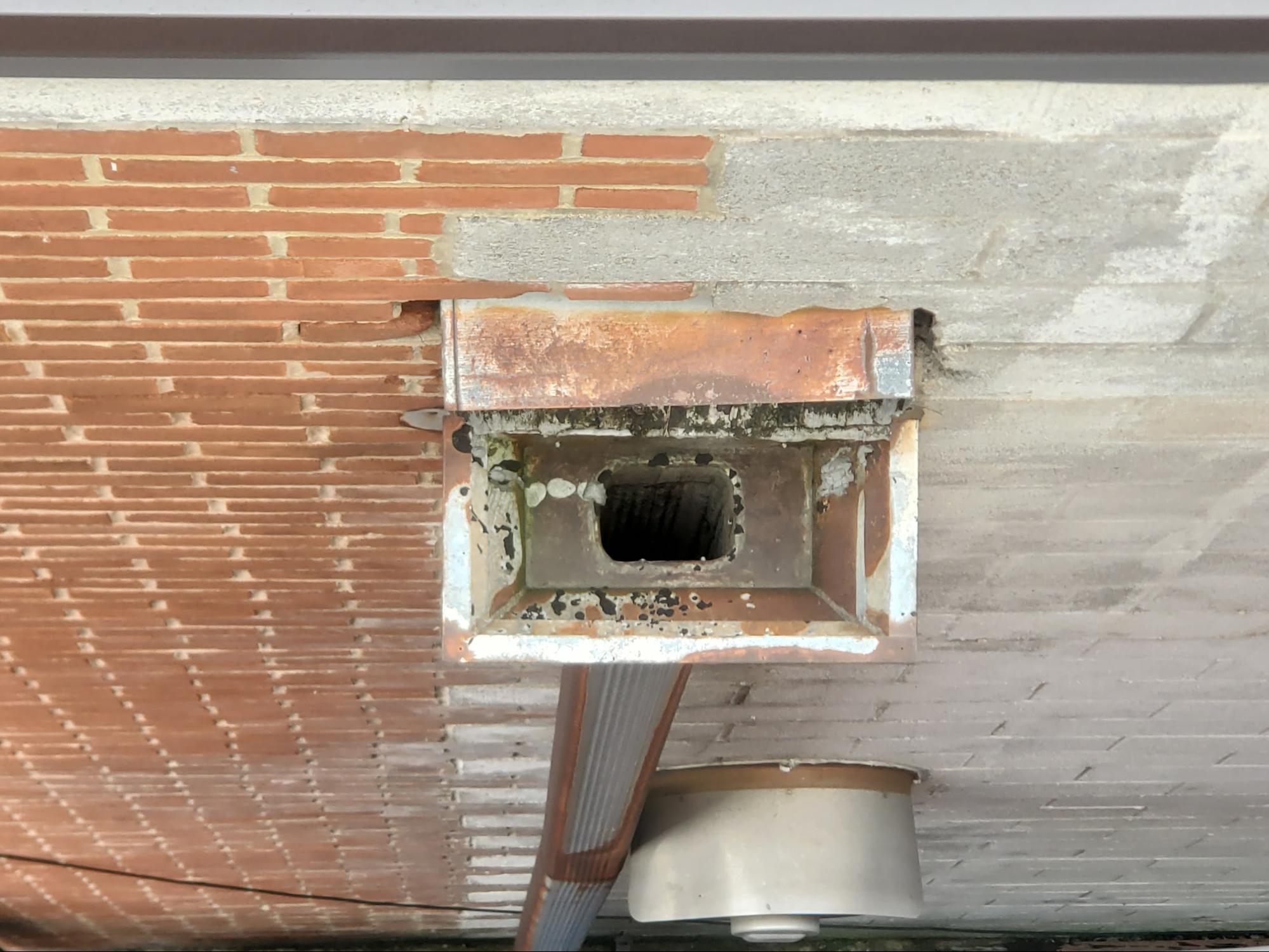
Scuppers - the through-wall or through-parapet overflow openings that serve as secondary drainage on many Denver commercial buildings - are chronically neglected. The primary drains get cleared; the scuppers accumulate debris, rusting metal liners, bird nesting material, and in Denver's case, compacted cottonwood that has bonded into the scupper opening over several seasons. A scupper that cannot function as emergency overflow provides no protection when the primary drain is overwhelmed during a May hailstorm or a heavy snowmelt event.
We clear scuppers of debris and inspect the metal liner and the exterior face of the opening. Scupper liners that have corroded or separated from the parapet face allow water to infiltrate the parapet wall assembly from behind rather than channeling it cleanly through the wall. We replace failed scupper liners with stainless or aluminum fabricated units sealed into the parapet wall with backer rod and polyurethane sealant.
On Denver buildings where scuppers serve as primary drainage - common on parapet-walled warehouse buildings in the older industrial districts along the South Platte River and in the Commerce City corridor - we size scupper openings against the roof area they drain and verify compliance with current International Plumbing Code drainage rate requirements. Undersized scuppers that were adequate for original drainage design but compromised by decades of debris accumulation and parapet modifications are a recurrent finding on our inspection routes in these older corridors.
Ponding Correction
Ponding deeper than one inch 48 hours after a rain or snowmelt event is a building code concern under IBC 2021 and the editions adopted across Denver-area jurisdictions. Chronic ponding also accelerates membrane degradation in Denver's freeze-thaw climate - water that remains on the roof into the evening in winter months freezes in place, creating ice loading and an ice-water interface at the membrane surface that works seam laps and flashing terminations open over multiple freeze cycles.
We address ponding at the source. If the drain is functioning and ponding results from insufficient roof slope, the correct repair is a tapered insulation fill that directs water to the drain. If the drain has settled or offset below the actual low point of the roof, we reposition the drain or install a secondary drain at the true low point. Temporary ponding correction that does not address the underlying cause is not a solution in Denver's climate, where the next winter turns ponded water into ice loading.
Tapered insulation fill for ponding correction is engineered against an actual elevation survey of the ponded area, not estimated from memory or a visual walk. We use a laser level to map the low points and design the taper package to achieve minimum one-quarter-inch-per-foot positive drainage to the drain across the corrected area.
Frequently asked questions
How often should Denver commercial roof drains be cleaned?
Annually at minimum, and after every significant debris-generating event - the May through August hail season, the cottonwood seed release that runs four to six weeks starting in late April, and the leaf fall from surrounding trees in October. Buildings in tree-dense areas like Cherry Creek, Washington Park, and the Capitol Hill commercial district need semi-annual cleaning. Buildings in open-terrain corridors like the I-70 and E-470 industrial zones may require cleaning only after storm debris events.
Can a drain be repaired without disturbing the roof membrane?
In some cases, yes. If the clamping ring is failed but the drain body and leader connection are intact, we can sometimes replace the ring and strainer assembly without full bowl extraction. We assess this on a case-by-case basis - the goal is always the minimum disturbance to an intact membrane.
What is the difference between drain cleaning and drain replacement in terms of cost?
Cleaning a blocked drain - pulling the strainer, clearing debris, verifying flow - is a maintenance item. Full drain replacement including bowl extraction, membrane integration, and leader inspection is a repair item that runs significantly higher depending on drain depth and membrane system. We quote both options after the inspection so you understand what you are deciding between.
Ponding on your Denver roof or drains backing up after rain?
| Scope Format | Written roof plan and photo record |
|---|---|
| Primary Market | Denver commercial buildings |
Commercial Re-Roofing in Denver, CO
Commercial Re-Roofing for commercial buildings across Denver.