60-mil EPDM Specification for Denver's Environment
EPDM commercial roofing installation and replacement on Denver industrial buildings - 60-mil mechanically attached and fully adhered systems, impact-rated cover board, manufacturer warranty closeout.
60-mil EPDM on Denver industrial and institutional buildings - mechanically attached or fully adhered, with FM 4470 Class 1 or UL 2218 Class 4 impact-rated cover board as standard, and replacement expertise on the 1980s and 1990s Colorado industrial inventory that is deep into its lifecycle.
EPDM was the dominant commercial roofing membrane on Denver-area industrial and institutional buildings through the 1980s and 1990s. The I-70 corridor warehouse and distribution buildings in Adams County and Aurora, the Jefferson County industrial parks along the Colfax Avenue industrial strip in Lakewood, and the early DTC office buildings constructed through the 1990s energy and telecommunications boom were largely roofed in 45-mil EPDM mechanically attached on metal deck. Much of that inventory is now 25 to 40 years old - well past the design life of the original membrane systems - and represents an active replacement cycle in the Denver market.
We have extensive experience with the end-of-life EPDM inventory on Front Range commercial buildings. We know the original deck conditions that were common on 1980s Colorado industrial construction, how the original mechanically attached patterns perform after 25 years of freeze-thaw cycling and Chinook wind loading, and what the recover-versus-replace analysis produces on these specific buildings. On many of the I-70 and Jefferson County industrial inventory, a single-ply TPO recover over existing dry insulation is the better capital decision than a full EPDM-to-EPDM replacement - and we say so when that is the honest answer.
On new and replacement installations, we install 60-mil EPDM in mechanically attached and fully adhered configurations. Denver's environment requires that every EPDM specification include an impact-rated cover board - HD polyiso or HD gypsum - as part of the insulation stack. Standard-density polyiso under EPDM on a Denver commercial building does not achieve FM 4470 Class 1 or UL 2218 Class 4 hail resistance, and the first significant hail event demonstrates why.
60-mil is the current commercial-grade standard for EPDM installations. The 45-mil systems common on 1980s and 1990s Colorado industrial construction had adequate performance in their design context, but the combination of altitude UV acceleration, 90 to 110 annual freeze-thaw cycles, and Colorado's documented hail frequency has pushed the measured service life of 45-mil systems shorter than the original design projections. We do not specify 45-mil EPDM on new Denver commercial work under any circumstances. The additional thickness at 60-mil provides meaningful improvement in puncture resistance, seam durability, and resistance to the hail impact and UV degradation that define Denver's membrane performance environment.
Mechanically attached EPDM: Fastened with screws and plates through seam laps into insulation and deck. Attachment pattern designed against the building's wind-uplift zone, exposure category, and zone classification per IBC 2021. Denver buildings near the urban edge - particularly on the western side of the metro where the terrain transition to the foothills accelerates surface wind speeds - often require Exposure C pattern density at perimeter and corner zones even on low-rise industrial buildings. Chinook wind events are the design case, not the worst-case outlier.
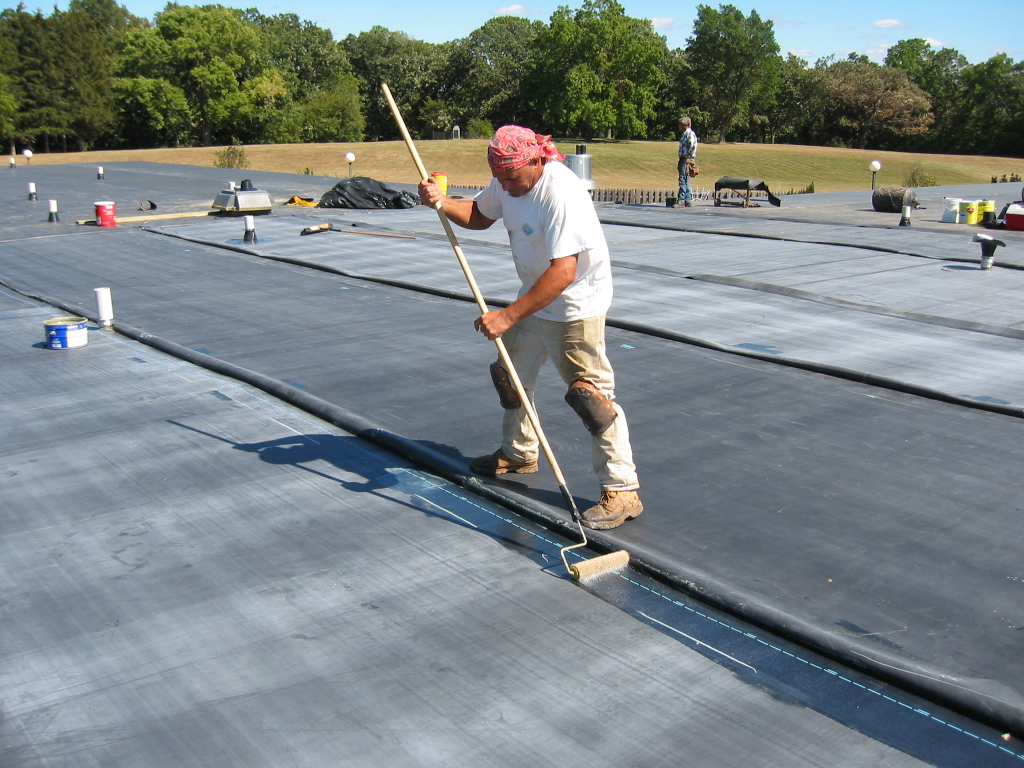
Fully adhered EPDM: Membrane bonded to the cover board or insulation surface with EPDM-compatible contact adhesive applied to both surfaces. Preferred over mechanically attached in Denver's environment for most commercial building types because the continuous bond eliminates the membrane flutter that fatigues seam laps under Chinook wind loading. Cold-temperature application windows require monitoring - EPDM contact adhesive requires temperatures above 40°F at the substrate for proper bond development, which constrains installation to April through October on most Denver commercial projects without heated-enclosure protocols.
End-of-Life EPDM Replacement on Denver and Aurora Industrial
The practical condition of 1990s 45-mil EPDM at end of life on a Denver industrial building: seam lap sealant is cracked and brittle from 25-plus years of freeze-thaw cycling, field membrane shows surface checking that ranges from cosmetic to a water pathway depending on remaining membrane thickness, and parapet base flashings have separated at multiple locations from cumulative thermal movement. These are not repair candidates in Denver's environment - each freeze-thaw season extends the seam failures and produces new flashing separations. They are replacement projects.
Our typical scope on I-70 corridor or Jefferson County industrial EPDM replacement: full membrane tear-off to deck, moisture survey on existing polyiso insulation with cores at ten locations per 50,000 sq ft of roof area, replacement of saturated insulation sections, installation of HD polyiso or HD gypsum cover board as part of the new insulation stack, new 60-mil EPDM or TPO membrane (owner preference and building use drive the selection), and manufacturer warranty closeout with impact-resistance certification documentation. We run sections of 5,000 to 10,000 sq ft per day with same-day dry-in - Denver's afternoon thunderstorm and hail season from May through August means no section is left open overnight during production.
Why some Denver industrial owners choose TPO instead of new EPDM for the replacement: TPO heat-welded seams install faster than EPDM adhesive seaming, TPO's white surface provides immediate cool-roof compliance under Colorado's energy code (IECC 2021), and TPO carries equivalent 20-year NDL warranty terms on 60-mil systems. EPDM's advantages are lower material cost, a longer proven track record on heavy-industrial and cold-storage applications in Colorado's temperature-swing environment, and better tolerance of chemical exhaust from HVAC systems in industrial environments. Both are valid specifications depending on the building's use and the owner's priorities.
EPDM in Denver Institutional and Healthcare Settings
EPDM is frequently specified at UCHealth and Denver Health satellite medical office buildings and the institutional inventory around the Anschutz Medical Campus in Aurora because it tolerates the chemical exhaust from healthcare HVAC systems - sterilant agents, chemical fume hood discharge, medical gas vent stacks - better than early-generation TPO formulations. Modern TPO is substantially more chemically resistant than the formulations that failed on healthcare buildings in the 2000s, but EPDM remains the conservative specification for facilities management teams that have direct experience with that earlier failure mode.
Fully adhered EPDM eliminates hot-air welding and open-flame operations entirely - a material factor in the hot-work permitting environment of occupied patient-care buildings. On the UCHealth and Denver Health campuses, the pre-construction hot-work permit process involves clinical operations coordination that can extend the pre-construction phase by two to four weeks. A system that eliminates the hot-work requirement simplifies that coordination even if the installation rate per square is slower than mechanically attached.
Frequently asked questions
Can an aging Denver EPDM roof be coated rather than replaced?
On an EPDM roof with dry insulation, sound field membrane, and no systemic seam failure, silicone over properly primed EPDM can extend life 10 to 15 years with a manufacturer warranty. EPDM requires solvent-based primer for silicone adhesion - skipping it produces coating delamination in Denver's UV environment within two to three years. On 1990s 45-mil EPDM with cracked lap sealant, multiple failed seams, and parapet flashing separation, coating is not a sustainable option - the coating will follow the underlying failures through the freeze-thaw cycle. We core-pull and assess every EPDM roof before recommending coating versus replacement, and we present both options with their respective costs and warranty terms.
Does fully adhered EPDM installation require heated enclosures in Denver winters?
EPDM contact adhesive requires ambient and substrate temperatures above 40°F for proper bond development. Below that threshold, the adhesive film does not form a continuous bond and the membrane can lift in cold weather. For Denver buildings where replacement must occur between October and April, we use heated enclosures on fully adhered projects or shift the specification to mechanically attached EPDM, which does not have the same temperature constraint. Mechanically attached installation can proceed in temperatures down to the manufacturer's minimum fastener-torque specification - typically above 20°F substrate temperature.
What warranty is available on 60-mil EPDM on a Denver industrial building?
EPDM replacement or inspection on a Denver industrial building?
We work across the I-70 corridor, Jefferson County industrial districts, and the Aurora commercial parks. Walk, core pull, moisture survey, and written scope - let us document what your building actually needs.
| Scope Format | Written roof plan and photo record |
|---|---|
| Primary Market | Denver commercial buildings |
Commercial Re-Roofing in Denver, CO
Commercial Re-Roofing for commercial buildings across Denver.