Insurance-Grade Documentation for Colorado Hail Claims
Insurance-grade hail damage documentation and permanent repair for Denver commercial flat roofs - event-damage versus pre-existing distinction, adjuster coordination, impact-resistance specification, and claim closeout documentation for Colorado's hail belt.
Denver sits in one of the most active hail corridors in the United States. Post-hail scope work starts with documentation that holds under adjuster review - not a quick walk and a bid number. We establish dated pre-adjuster records, distinguish event damage from pre-existing conditions, and deliver permanent repair, not emergency patch.
Colorado ranks in the top three states nationally for annual hail frequency and insured hail losses. The Denver metro's May through August season is not a regional anomaly - it is the defining environmental condition for commercial roofing in this market. The June 2023 storm that tracked through the Stapleton and Aurora corridors produced two-inch stones across a wide swath of Adams and Arapahoe counties and generated hundreds of commercial roof claims. The August 2024 event that moved through Jefferson County, striking Lakewood and Wheat Ridge industrial buildings, produced documented golf-ball-sized stones on several commercial corridors. After every event of that scale, there is a window - typically 30 to 90 days - in which documentation quality determines whether a claim is paid, partially paid, or denied.
Our hail damage work follows a specific sequence: independent roof walk within 48 hours of the event to establish dated pre-adjuster documentation, adjuster walk with our project manager present, written scope distinguishing event damage from pre-existing conditions, permanent repair with documented materials and installation records, and a post-repair photo record that closes the claim file. We have worked this sequence on commercial buildings across Denver County, Adams County, Arapahoe County, and Jefferson County, and we understand what adjusters from Colorado's major commercial carriers look for and what documentation actually moves a disputed claim to resolution.
We do not do storm-chasing sales work. We document what the storm did, we distinguish it from what was already there, and we repair what the storm damaged. Carriers have long memories for contractors who inflate claims - that approach damages adjuster relationships that building owners depend on for future coverage and future claims.
A commercial hail claim requires documentation establishing three things: that a hail event occurred, that the event caused the observed damage, and that the observed damage is distinct from pre-existing conditions. The first is established by NOAA storm reports and third-party weather verification services that Colorado adjusters rely on. The second requires photographs showing hail impact signature - spatter patterns on rooftop AC condenser fins (the most reliable hard-surface benchmark), dented pipe boots, fractured granules on modified bitumen, bruising and splits on TPO and EPDM membrane consistent with the documented stone size.
The third - distinguishing event damage from pre-existing conditions - is where most commercial claims generate disputes in the Colorado market. We photograph and describe every area of membrane degradation during our pre-adjuster walk, noting whether the condition is consistent with hail impact or with age-related degradation. We document both honestly. Our reputation with Colorado adjusters depends on accuracy, not advocacy, and a reputation for accurate documentation is worth far more over a five-year carrier relationship than any single claim inflation.
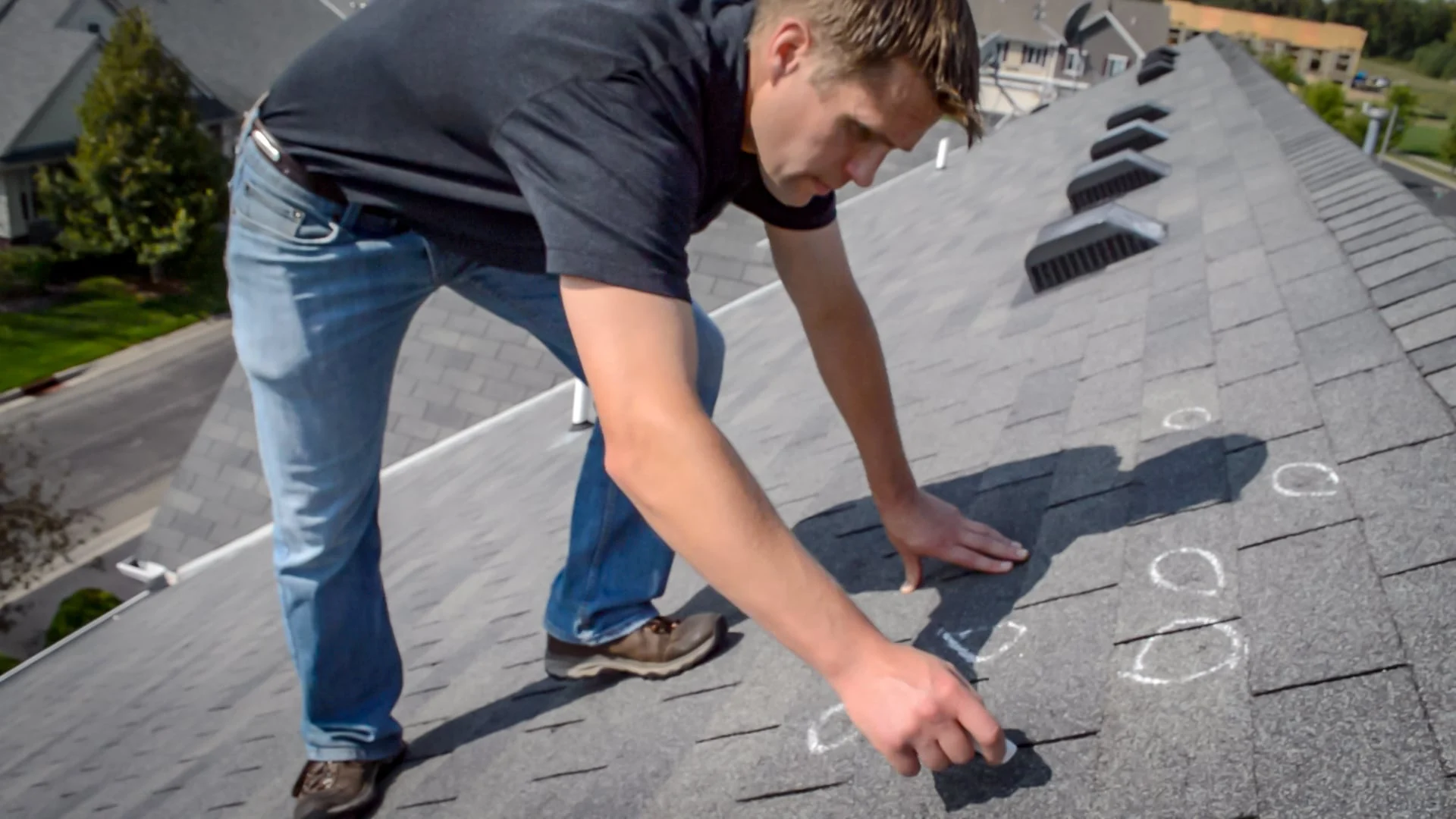
We measure hail impact density - impacts per 10 sq ft - in multiple locations across the roof. Colorado adjusters cross-reference density readings against storm path data from NOAA and from their own weather verification services. We use a painted test square to establish a count baseline that the adjuster can replicate independently during their walk.
Hail Damage Patterns on Denver Commercial Roofs
TPO and EPDM membranes: Hailstones above 1.5 inches leave visible bruising and occasional fractures through 60-mil TPO, particularly at seam lines where the membrane is bonded to the substrate and cannot absorb impact through deflection. The cover board specification is the critical variable - HD polyiso cover board significantly reduces penetration depth and membrane fracture compared to standard-density board. Buildings with impact-rated cover board in the spec sustain the kind of surface damage that supports a documented claim and a defined repair scope; buildings without cover board sustain punctures and insulation compression that require a broader scope and produce more contested claims.
Modified bitumen: Granule displacement is the primary indicator on granule-surfaced modified bitumen, common on Denver commercial buildings from the 1980s and 1990s energy-sector construction wave along 17th Street and in the Inverness business park along I-25 south. Impact craters without granule coverage expose the base sheet to Denver's high-altitude UV and accelerate membrane degradation at a rate faster than at sea-level markets.
Metal components: Parapet coping caps, metal edge flashings, pipe boots, skylight frames, and HVAC equipment covers all show spatter damage that serves as hard-surface hail evidence. We photograph all metal components on every post-hail walk. Colorado adjusters weight hard-surface evidence heavily because it is unambiguous - a dented condenser fin is not a pre-existing condition.
Cover board integrity: One of the most important post-hail assessments in the Denver market is verifying cover board integrity below an apparently intact membrane. We pull cores after significant hail events specifically to check whether the cover board has been fractured or compressed below a surface that looks intact. A fractured cover board under intact membrane is not an immediate leak source, but it eliminates the roof's impact-resistance rating for the next event and should be documented and scoped for repair before the next hail season.
Working with Colorado Adjusters
We schedule adjuster walks at the adjuster's convenience and have our project manager present for the full walk. We do not send a salesperson - we send the person who will manage the repair, because the adjuster's questions are technical and the answers need to be accurate.
When an adjuster's scope and our scope differ, we document the discrepancy in writing and request a re-walk or a third-party umpire inspection. Most scope discrepancies on Colorado commercial claims arise from the adjuster not walking the full roof or not understanding how Denver's hail belt damage presents differently on an impact-rated system versus a non-rated system. We know how to have this conversation in a way that produces resolution.
We produce all repair documentation in the format the carrier's file requires - itemized scope, unit pricing, materials schedule, and post-repair photos keyed to the pre-repair documentation. This is what allows a claim file to close cleanly. At closeout, we also provide the impact-resistance certification for any system that was rebuilt to Class 4 specification, which supports the building's next insurance renewal.
Frequently asked questions
How quickly should we get on the roof after a Denver hail event?
Within 48 hours if possible. Most commercial policies have a prompt-notice provision, and dated pre-adjuster documentation protects you against the carrier arguing that damage found later was not caused by the event. We prioritize post-hail walks during hail season and can typically get a project manager on your roof within one to two business days of a significant Denver metro event.
What if our adjuster says the damage is pre-existing?
We document both event damage and pre-existing conditions independently on every post-hail roof walk. If we have pre-adjuster documentation showing damage that was not present before the event, that record supports your position in a dispute. We will walk the roof again with the adjuster and go through the documentation side by side. The pre-storm inspection program exists precisely for this situation.
Do you work with Colorado's major commercial carriers?
We have worked with the major commercial carriers active in the Colorado market - Travelers, Hartford, Zurich, FM Global, and several regional and surplus-lines programs that write hail-exposed Colorado commercial risks. Each carrier has different documentation preferences and we adapt our report format accordingly.
| Scope Format | Written roof plan and photo record |
|---|---|
| Primary Market | Denver commercial buildings |
Commercial Re-Roofing in Denver, CO
Commercial Re-Roofing for commercial buildings across Denver.