When Infrared Scanning Is Appropriate in Denver
Infrared thermography moisture detection for Denver commercial flat roofs - identifying wet insulation before tear-off, validating recover decisions under Colorado hail exposure, and documenting moisture boundaries for insurance and capital planning.
Infrared thermography maps wet insulation under a membrane before you open the roof. In Denver's freeze-thaw climate, trapped moisture does not just accelerate membrane aging - it becomes an expansion-contraction engine that destroys the membrane bond and corrodes the deck. We scan, confirm with cores, and give you a moisture map before you commit capital.
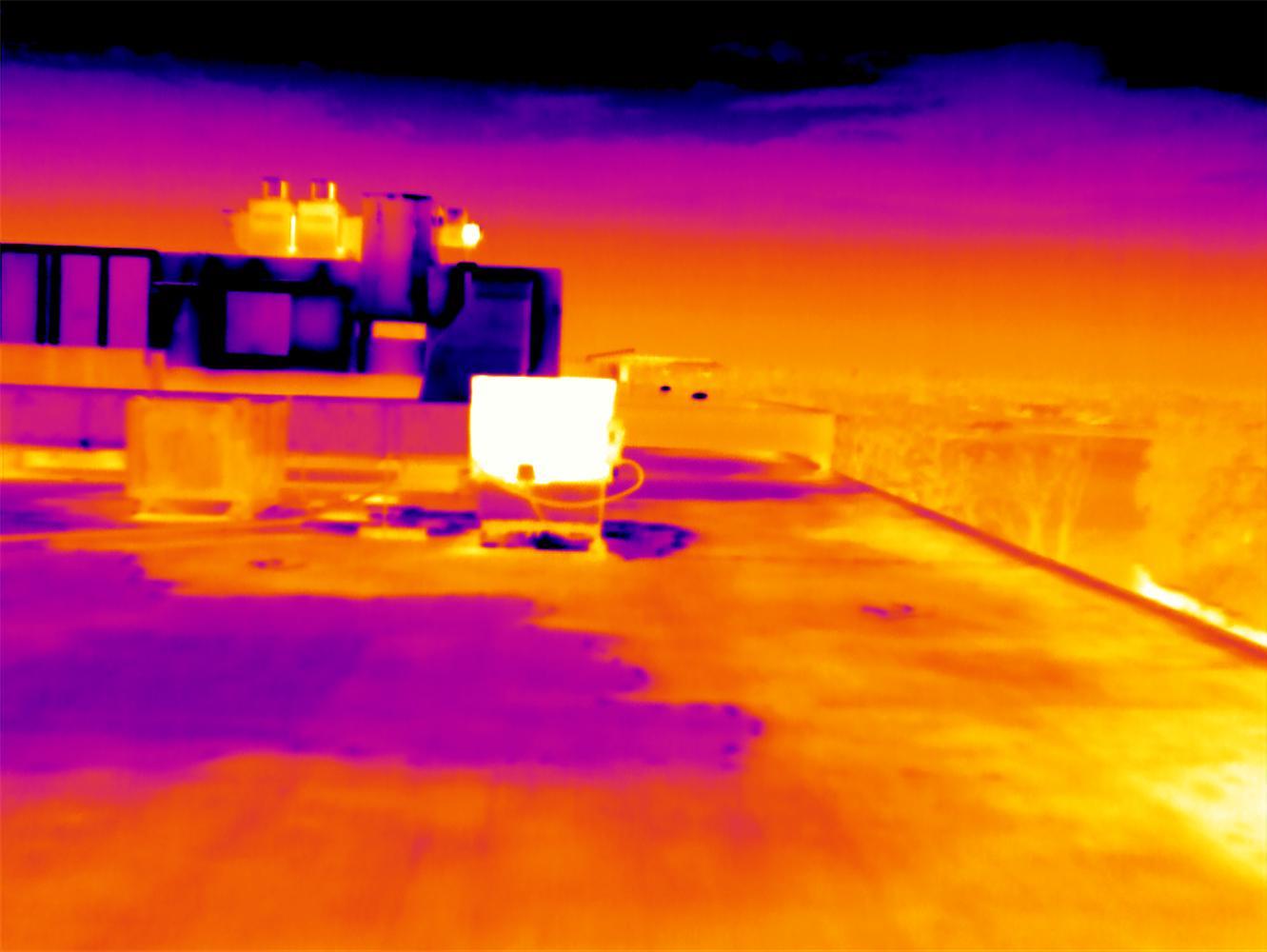
Saturated roof insulation is invisible from the surface. A TPO membrane on a Denver commercial building that looks intact from a roof walk may be sitting on polyiso insulation that has been wet through two hail seasons. The only way to know before you open the roof is to scan it thermally or pull cores. Infrared scanning tells you where to pull cores and - on roofs with sufficient thermal contrast - delivers a moisture boundary map that guides the scope without requiring you to open every suspect area.
We operate a FLIR thermal camera on Denver commercial roofs on evening assessments, typically 45 to 90 minutes after sunset, when the roof membrane has cooled and wet insulation retains the day's solar heat longer than dry insulation, producing a detectable warm anomaly against the cooler dry field. Denver's high-altitude solar intensity means that thermal contrast on clear days is often stronger than in lower-elevation markets - the differential loading that the scan depends on is more pronounced, which improves detection reliability on well-maintained roofs with isolated wet zones.
Infrared scanning is a decision-support tool, not a final answer. We use it in combination with core sampling: the scan identifies suspect zones, the cores confirm moisture content and verify the thermal read. For recover-versus-replace decisions on Denver warehouse and office buildings in the 50,000 to 300,000 sq ft range, this combination consistently delivers more accurate scope than a visual inspection alone - and typically costs far less than full tear-off discovery.
Pre-recover decision: Before committing to a recover versus full replacement on an aging Denver commercial roof, an infrared scan tells you how much of the existing insulation is dry and recoverable. If less than 25 percent of the roof reads as wet, recover with targeted insulation replacement is typically the sound choice. If more than 25 percent is wet, replacement is the defensible scope - recovering wet insulation in Denver's freeze-thaw climate traps moisture that cycles through freeze-expand-thaw events all winter, voiding the new system's warranty and accelerating deck corrosion.
Post-hail or post-storm assessment: After a significant hail event, infrared scanning identifies membrane compromise not visible as an obvious puncture. Denver's May through August hail season routinely delivers stones large enough to fracture a cover board without penetrating the membrane outright - a condition that creates a compression void that water finds during the next rain event. Infrared detection of that insulation compromise, confirmed by core sampling, is the basis for a documented insurance claim that holds under adjuster review.
Pre-sale or pre-refinance documentation: Buyers and lenders increasingly request infrared moisture scan reports as part of commercial roof due diligence on Denver properties. Colorado's hail exposure history makes this particularly relevant - a scan report with a clean moisture map and a confirmed cover board specification provides meaningful assurance to a buyer's underwriter. We produce signed, dated scan reports with thermal images and a written moisture boundary summary for this purpose.
Warranty investigation: When a building owner believes a roof is leaking but the contractor disputes the source, an independent infrared scan produces an objective record of moisture location. We have conducted these third-party scans on buildings along the I-25 Tech Center corridor and at medical-office buildings in the I-225 Aurora corridor where the building owner needed an independent moisture assessment to advance a dispute.
How We Conduct the Scan
Timing is critical. The scan must be conducted after sufficient daytime solar loading and after the surface has begun to cool. Denver's high-altitude sun provides strong differential heating even on days with moderate air temperatures - the scan window in Denver runs reliably from April through October, with the peak reliability period from June through August when daytime solar load is at its maximum and the 45-to-90-minute post-sunset window produces the strongest thermal contrast.
We walk a grid pattern across the roof surface, capturing overlapping thermal frames and recording GPS coordinates at each frame. The thermal images are stitched into a roof plan overlay showing warm zones against the cool dry field. All images are saved with the camera's metadata intact - date, time, ambient temperature, camera settings - for the report record.
Core sampling follows the scan: we pull three-inch cores at the centroid of each warm zone identified, plus two control cores in areas the scan read as dry. The cores confirm moisture content and verify the scan's accuracy. On Denver commercial roofs we have scanned, the thermal read is accurate within plus-or-minus one zone, with a low false-positive rate on anomalies given the strong thermal contrast Denver's high-altitude sun provides.
Limits of the Technique
Infrared scanning does not penetrate the deck. It reads moisture in the insulation layer directly below the membrane - not in the structural deck and not in the interior of the building. Deck corrosion on pre- office corridor is a visual and probe finding, not a thermal finding.
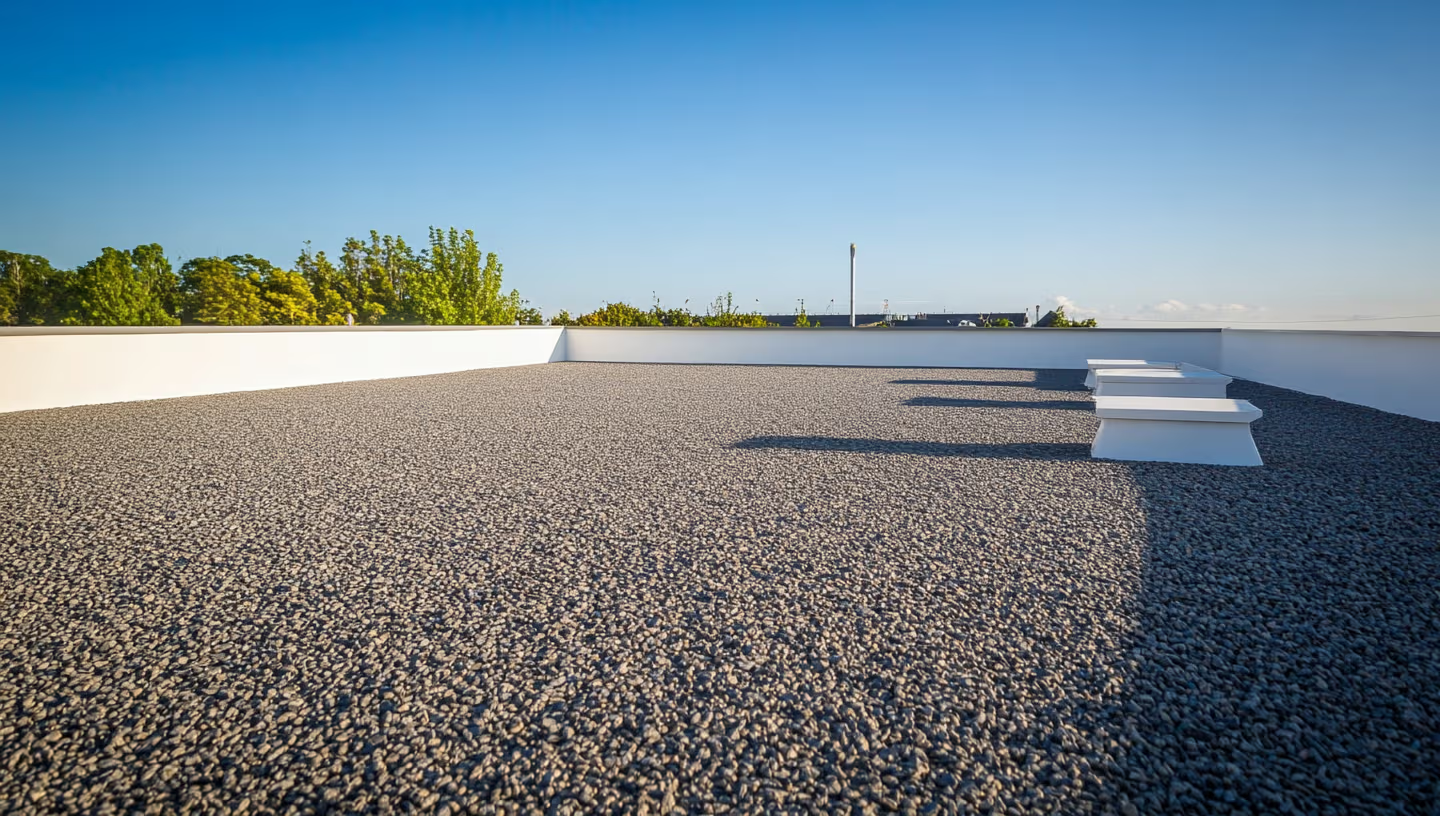
The technique is unreliable on roofs with ballasted stone or pavers, roofs where photovoltaic arrays cover more than 30 percent of the surface, and roofs where recent rainfall has uniformly saturated the entire surface - there is no dry baseline to contrast against in that condition.
Denver rooftop HVAC units and mechanical penthouses create localized warm zones that can mask adjacent moisture anomalies or be mistaken for moisture. We flag these in the scan report and verify them by core or probe sampling rather than treating them as confirmed moisture findings. The Anschutz campus buildings and the large Class A office towers along 17th Street have dense rooftop equipment populations that require careful scan interpretation.
A scan report is a planning document, not a warranty. We do not warrant the scan as a complete inventory of all moisture in the assembly. The report describes what thermal imaging detected and where cores confirmed moisture, and gives the owner the information needed to scope repair or replacement intelligently.
Frequently asked questions
How much of the roof area does the scan typically identify as wet on aging Denver commercial buildings?
It varies widely. Denver office buildings from the 1990s energy-sector boom along 17th Street that are on original or first-replacement modified bitumen often read 30 to 50 percent wet - those roofs have been deferring for years and have absorbed moisture through multiple hail seasons. Newer buildings from the 2000s LoDo redevelopment wave with maintained TPO systems often read under 10 percent wet even at 15 years of age. The scan tells you where you actually are, which is usually different from where you assume you are.
Do you scan during the day or at night?
Evening, after sunset. Denver's high-altitude daytime surface temperatures make daytime scanning unreliable - the radiant heat from the membrane itself masks the differential between wet and dry insulation. The 45-to-90-minute post-sunset window is when thermal contrast is most reliable. In practice, Denver's clear-sky nights during the June through August hail season produce some of the most reliable scan conditions we encounter.
Can the scan report be used for a Colorado insurance claim after a hail event?
| Scope Format | Written roof plan and photo record |
|---|---|
| Primary Market | Denver commercial buildings |
Commercial Re-Roofing in Denver, CO
Commercial Re-Roofing for commercial buildings across Denver.