Attachment Method Selection for Denver Buildings
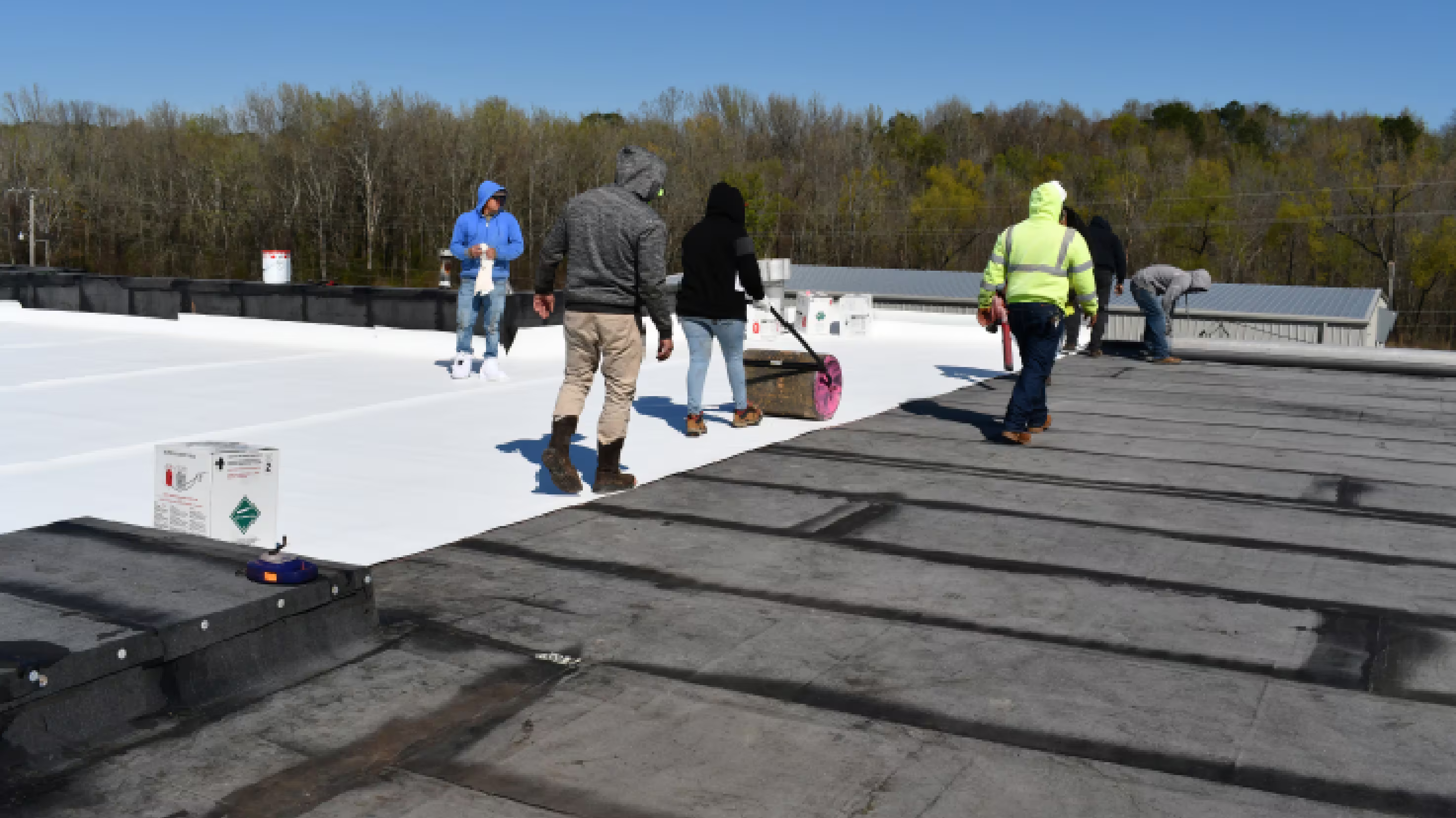
Single-ply roofing for Denver commercial buildings - mechanically attached and fully adhered TPO, PVC, and EPDM with FM 4470 Class 1 or UL 2218 Class 4 impact-rated cover board as standard for Colorado's hail belt.
TPO, PVC, and EPDM single-ply membranes specified and installed for Denver's actual environment - altitude UV, 30 psf snow loads, Front Range Chinook winds, and annual hail exposure that demands FM 4470 Class 1 or UL 2218 Class 4 impact-rated cover board in every system.
Single-ply dominates new commercial roofing in Denver for the same reasons it dominates nationally: installation speed, manufacturer warranty confidence, reflective membrane compliance with Colorado energy code, and a 30-plus-year track record in the Front Range climate. TPO, PVC, and EPDM account for the large majority of new commercial membrane installations across Denver County and the surrounding metro counties. What makes a Denver single-ply specification different from a generic one is the environmental requirement stack: altitude UV degradation running 25 to 30 percent faster than sea level, 90 to 110 annual freeze-thaw cycles driving flashing and expansion joint failures, 30 psf ground snow load under ASCE 7-22, Chinook wind events producing sustained gusts above 60 mph along the Front Range, and an annual hail season that makes FM 4470 Class 1 or UL 2218 Class 4 impact resistance a practical requirement rather than an insurance preference.
The attachment method decision is where Denver single-ply specifications earn or lose their long-term value. Mechanically attached systems are economical and fast but generate membrane flutter under Chinook gusts that fatigues seam laps over time in a way that does not occur in markets without sustained high-wind events. Fully adhered eliminates flutter but requires a dimensionally stable cover board substrate, which - in Denver's hail belt - should be HD polyiso or HD gypsum regardless of attachment method. We design the attachment method into the scope document with the wind-uplift calculation, the substrate assessment, and the cover board specification presented explicitly, not buried in a line item.
Every single-ply system we install in Denver includes HD cover board as a non-negotiable component. Standard-density polyiso under a single-ply membrane is code-compliant but fails to qualify for FM 4470 Class 1 or UL 2218 Class 4 impact resistance - the rating that most Colorado commercial property insurers require for premium qualification and that the Denver hail environment demands in practice. The cover board is in every Denver spec we write.
Mechanically attached: Appropriate for Denver commercial buildings with metal deck substrates, standard roof height, and building locations that do not experience the accelerated wind exposure of foothills sites or exposed elevated locations. Attachment pattern - screws and plates per linear foot of seam - is designed per the membrane manufacturer's FM Global or UL wind-uplift design tables for the building's height, exposure category, and zone classification. Perimeter and corner zones require substantially higher fastener density than field zones, and Denver's Chinook wind pattern means this density difference is not a code technicality - it is the design load the perimeter zone will see in a routine wind event.
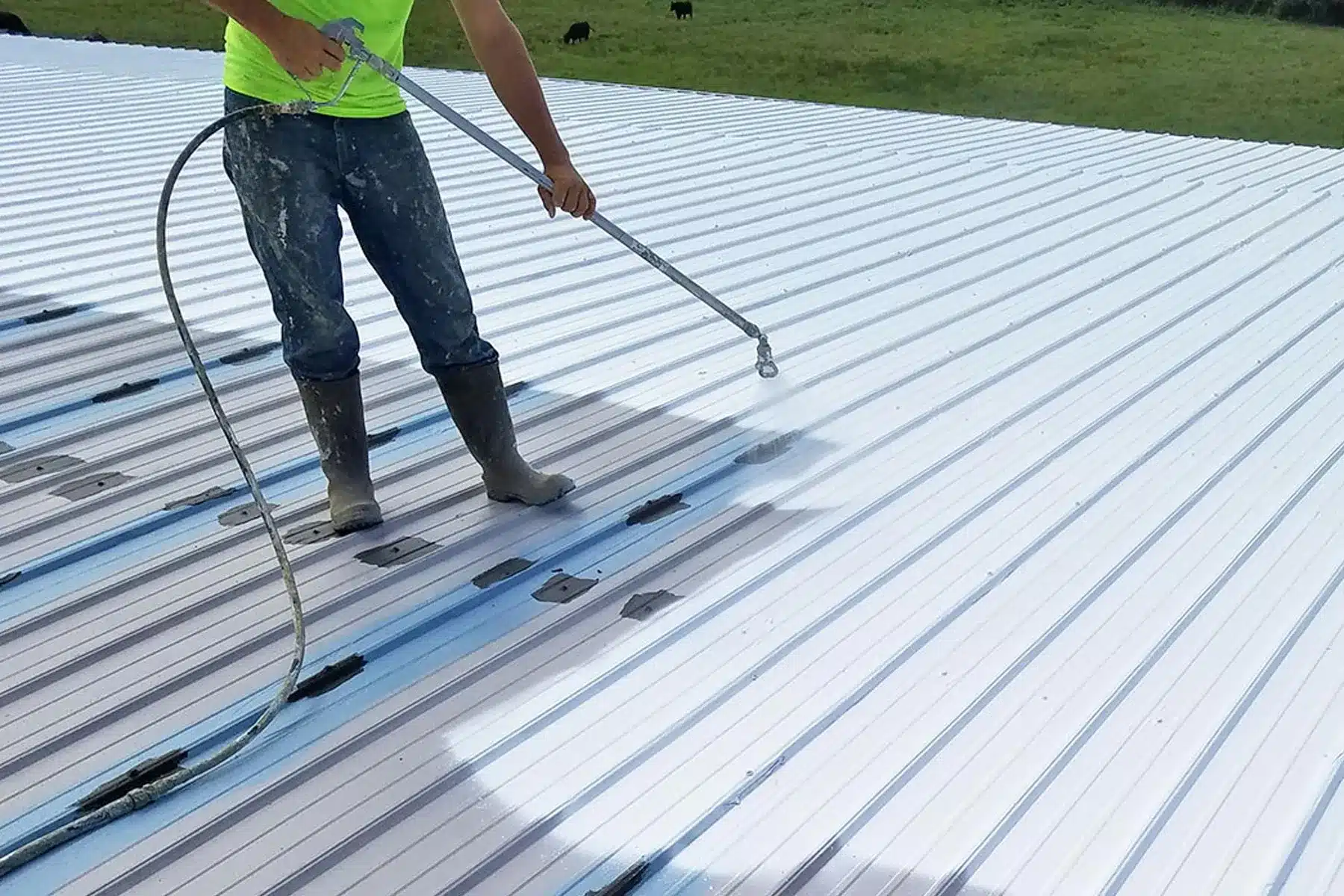
Fully adhered: Preferred for most Denver commercial building types in our specification practice. The continuous adhesive bond eliminates membrane flutter under Chinook wind loading, which reduces the seam fatigue that produces early perimeter failures on mechanically attached systems exposed to sustained high winds. Fully adhered also eliminates the uplift risk that hail impact creates on loose-laid or partially restrained assemblies. Adhesive selection is system-specific - TPO requires a water-based or solvent-based TPO-compatible adhesive, EPDM requires contact cement, PVC requires PVC-formulated bonding adhesive. Cross-system adhesive substitution voids the manufacturer warranty and produces adhesion failure within the first thermal cycle season.
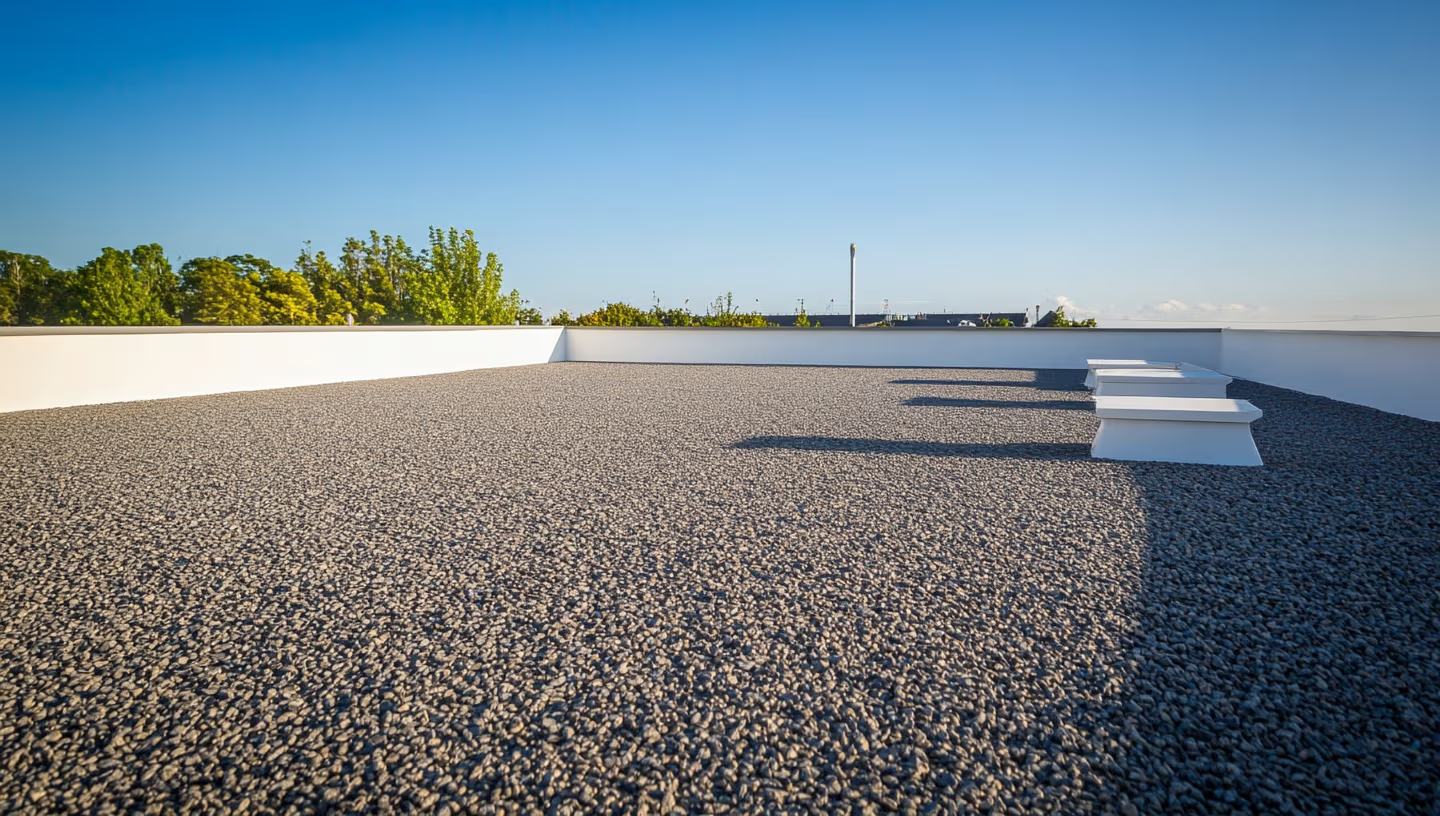
Ballasted: Membrane loose-laid under washed river stone ballast at 10 to 12 psf. No fasteners, no adhesive. Denver commercial buildings under ASCE 7-22's 30 psf ground snow load design value have limited structural margin for the additional ballast dead load on most metal deck systems - ballast plus snow load combined approaches or exceeds the deck design capacity on light-gauge steel construction. We do not specify new ballasted single-ply on Denver commercial buildings. Where existing ballasted systems exist on pre-1990 construction, we evaluate the structural margin before recommending a ballasted recover versus a full tear-off to reduce dead load.
Membrane Selection - TPO vs. PVC vs. EPDM in Denver
TPO: Default specification for Denver commercial buildings without chemical exposure concerns. Heat-welded seams, white reflective surface for IECC cool-roof compliance, 20-year NDL warranty paths at 60-mil and 80-mil. Material cost is the most economical of the three membrane types. Denver's altitude UV environment makes 60-mil the minimum commercial-grade specification - 45-mil TPO, still occasionally proposed on budget projects, does not achieve adequate longevity in the high-UV, freeze-thaw-intensive Denver environment.
EPDM: Thermoset membrane with the longest proven track record on Denver industrial applications. Adhesive-bonded seams require specifically trained crews - not the same as TPO heat-welding crews, and cross-training without proper qualification produces seam failures within the first freeze-thaw season. Preferred for cold-storage applications, heavy-industrial buildings with chemical exhaust from HVAC systems, and institutional buildings where the conservative specification of a 30-year proven membrane is preferred over newer formulation systems. 20-year NDL available at 60-mil.
Denver Climate Factors in Single-Ply System Design
Altitude UV and thermal cycling: Denver rooftops experience surface temperatures from below zero in January to 160°F plus in July on dark membrane surfaces. White and light-gray reflective membranes substantially reduce the summer peak and the seasonal temperature swing, which reduces thermal fatigue at seams and parapet transitions. Fully adhered systems on Denver commercial buildings require properly detailed expansion joints at column lines and at intervals of 100 to 150 feet - membrane stress cracking at parapet corners is the consistent failure mode on large fully adhered projects that were installed without expansion joint detailing.
Hail and cover board: FM 4470 Class 1 and UL 2218 Class 4 impact resistance requires HD polyiso or HD gypsum cover board in the insulation stack - this is the specification requirement that most low-bid contractors omit and the one that the first significant Front Range hail event makes visible. We provide FM 4470 Class 1 or UL 2218 Class 4 assembly certification documentation at closeout on every Denver single-ply installation. Colorado commercial property insurers use this documentation in premium underwriting, and we make it available in the format their underwriters require.
Snow load and structural coordination: Denver's 30 psf ground snow load requirement under ASCE 7-22 affects roof system selection most directly on ballasted roofs, but it also informs membrane design decisions for roofs with drains in interior field locations. Drain placement and overflow scupper sizing on Denver commercial roofs must account for the combined snow-melt and rainfall drainage volume during rapid-thaw events - the January 2024 warm-up after a sustained December cold period produced several Denver commercial buildings with drain systems undersized for the rapid melt volume.
Frequently asked questions
How do you determine the right attachment method for my Denver building?
We need the building location for wind exposure category determination, the deck type, the building height, and whether the building is in a foothills or elevated-terrain location with accelerated wind exposure. We run the wind-uplift calculation per IBC 2021 and FM Global design tables, assess the deck condition during the inspection walk, and present the cost and performance comparison between mechanically attached and fully adhered in the written scope. You see the calculation and the reasoning, not just a recommendation.
Is HD cover board really required on Denver commercial single-ply installations?
Required for FM 4470 Class 1 or UL 2218 Class 4 impact-resistance qualification - yes, unconditionally. Standard-density polyiso is code-compliant under IBC 2021 but does not achieve the impact-resistance rating that most Colorado commercial property insurers require for premium qualification. The cover board runs approximately $0.30 to $0.50 per square foot premium over standard-density insulation. On a 50,000 sq ft Denver commercial building, that is $15,000 to $25,000 in added installed cost. The annual insurance premium reduction for Class 4 qualification typically recovers that premium within three to five years on a building of that size.
Can single-ply be installed over an existing Denver roof without full tear-off?
Yes - recover is common in the Denver market on buildings with one existing roofing layer and dry insulation confirmed by moisture cores. Building code limits most Denver commercial roofs to two total layers before tear-off is required. Many Denver buildings in the DTC, I-70 corridor, and suburban office parks are strong recover candidates - the existing system provides a stable substrate, and recover avoids tear-off and disposal cost. We verify insulation moisture status and deck condition through inspection ports under wet core locations before recommending recover.
What is the difference between an FM-rated and a manufacturer-warranted single-ply system on a Denver commercial building?
FM Global ratings - FM 4470 Class 1 - are third-party assembly ratings covering both hail resistance and wind uplift, used primarily by commercial property insurers. Manufacturer NDL warranties cover material and installation defects over time. The two are separate documents addressing separate concerns. Denver building owners with FM Global property insurance policies are often contractually required to install FM-approved assemblies - we design to those ratings and provide the FM compliance assembly number at closeout.
| Scope Format | Written roof plan and photo record |
|---|---|
| Primary Market | Denver commercial buildings |
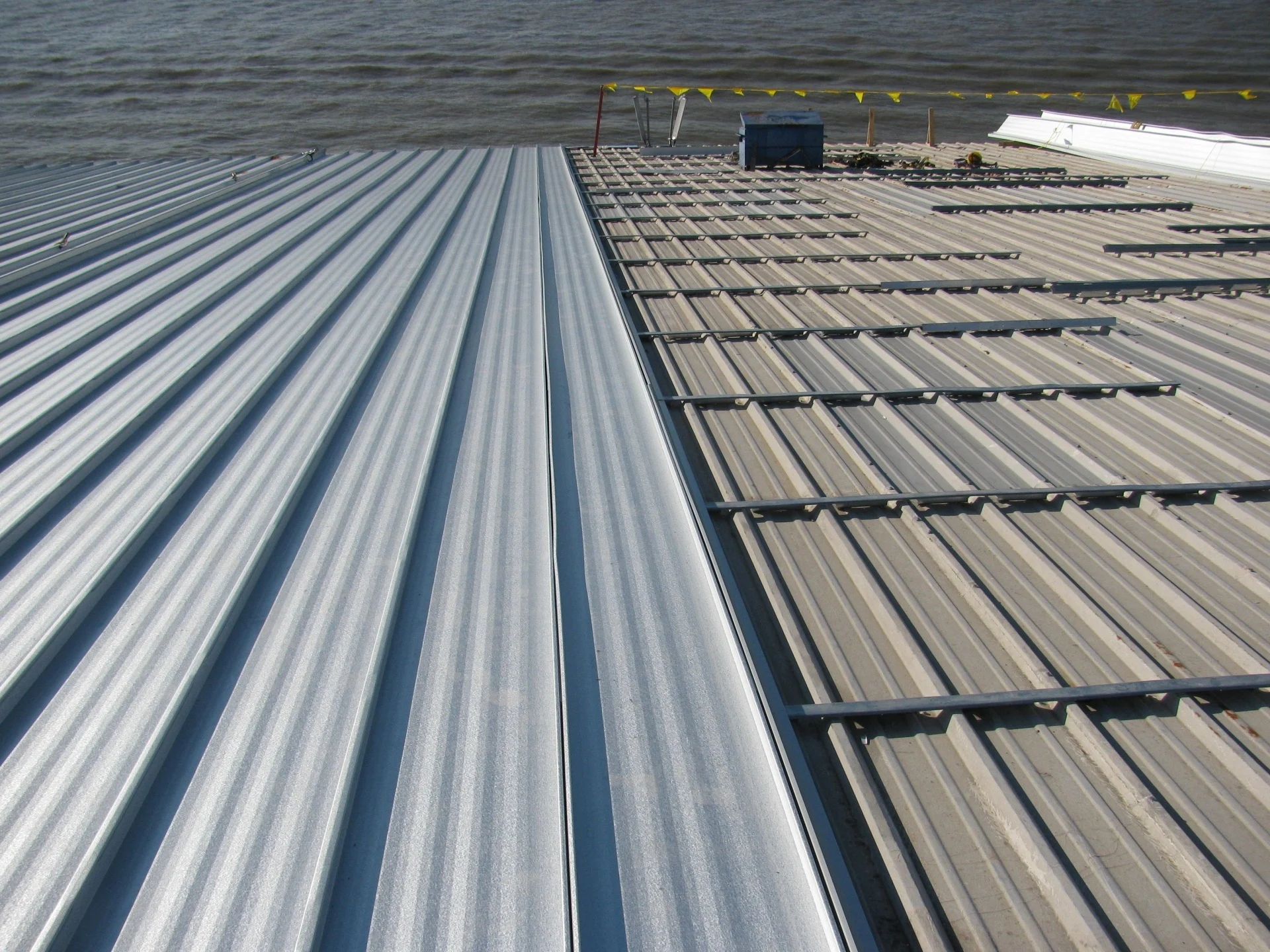
Commercial Re-Roofing in Denver, CO
Commercial Re-Roofing for commercial buildings across Denver.